
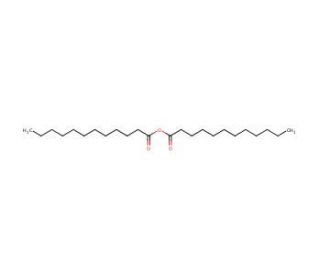

Dodecanoic anhydride (CAS 645-66-9)
Direktverknüpfungen
Dodecansäureanhydrid, ein Fettsäurederivat, ist weithin für seine Anwendung in der organischen Synthese und der materialwissenschaftlichen Forschung bekannt. Als Acylierungsmittel wird es eingesetzt, um Dodecanoylgruppen in verschiedene Substrate wie Alkohole, Amine und Phenole einzuführen und so die Synthese von Estern und Amiden zu unterstützen. Diese Eigenschaft macht sie zu einem wertvollen Hilfsmittel bei der Entwicklung von Tensiden, Schmiermitteln und Weichmachern, bei denen langkettige Fettsäureester für die Veränderung von Oberflächeneigenschaften unerlässlich sind. In der Polymerwissenschaft spielt es eine entscheidende Rolle bei der Acylierung natürlicher Polymere wie Stärke und Zellulose, wodurch deren Hydrophobie, thermische Stabilität und mechanische Eigenschaften erheblich verbessert werden. Durch diese Modifizierung eignen sich die Polymere für die Verwendung in Beschichtungen, Klebstoffen und biologisch abbaubaren Folien. Darüber hinaus ist Dodecansäureanhydrid ein wichtiges Reagenz für die Untersuchung von Veresterungsprozessen und Katalysatoreffizienzen, das Forschern hilft, die Reaktionskinetik und die Wirksamkeit verschiedener Katalysatoren bei der Estersynthese zu verstehen. In der Oberflächenchemie hilft es bei der Modifizierung von Substraten, um spezifische Oberflächenenergien, Adhäsions- und Benetzungseigenschaften zu erzielen, die für Anwendungen wie Korrosionsschutzbeschichtungen und moderne Verbundwerkstoffe von entscheidender Bedeutung sind. Insgesamt machen die Vielseitigkeit und die Reaktivität von Dodecansäureanhydrid es unverzichtbar für die Erforschung fortschrittlicher Materialformulierungen und die Verbesserung unseres Verständnisses der Mechanismen der organischen Synthese.
Dodecanoic anhydride (CAS 645-66-9) Literaturhinweise
- Studien über die Zusammensetzung von Adjuvantien, die selektiv die verzögerte Überempfindlichkeit gegen lipidkonjugierte Proteinantigene verstärken. | Champlin, R. and Hunter, RL. 1975. J Immunol. 114: 76-80. PMID: 1089714
- Immunisierung mit einem lipidkonjugierten Membranantigen zur Unterdrückung des Wachstums eines durch das Affenvirus 40 induzierten Fibrosarkoms. | Hunter, RL. and Strickland, F. 1975. J Natl Cancer Inst. 54: 1157-63. PMID: 165307
- Strukturelle Auswirkungen von Endgruppen auf den nicht-enzymatischen und enzymatischen Abbau von endverkapptem Poly(L-lactid). | Kurokawa, K., et al. 2008. Biomacromolecules. 9: 1071-8. PMID: 18275150
- Selbstorganisationsverhalten und Doxorubicin-Ladekapazität von acylierten Carboxymethylchitosanen. | Liu, KH., et al. 2009. J Phys Chem B. 113: 11800-7. PMID: 19678632
- Chemische Modifizierung und Immunogenität von Membranfraktionen aus Mäusetumorzellen. | Staab, HJ. and Anderer, FA. 1978. Br J Cancer. 38: 496-502. PMID: 215180
- Neue grüne Synthese und Formulierungen von Acyclovir-Prodrugs. | de Regil-Hernández, R., et al. 2011. Chem Pharm Bull (Tokyo). 59: 1089-93. PMID: 21881250
- Idiotyp-Impfung gegen B-Zell-Lymphome der Maus. Humorale und zelluläre Voraussetzungen für die volle Ausprägung der Antitumor-Immunität. | Campbell, MJ., et al. 1990. J Immunol. 145: 1029-36. PMID: 2373859
- Ein minimaler biochemischer Weg zur de-novo-Bildung synthetischer Phospholipidmembranen. | Bhattacharya, A., et al. 2019. Nat Commun. 10: 300. PMID: 30655537
- Immunreaktion von Meerschweinchen auf zwei verschiedene Lipidkonjugate von Rinderserumalbumin. | Singh, SB. and Leskowitz, S. 1978. J Immunol. 120: 734-8. PMID: 632585
- Eine vergleichende Studie über die Wirksamkeit verschiedener Verfahren zur Bindung von zwei Proteinen (L-Asparaginase und Meerrettichperoxidase) an die Oberfläche von Liposomen. | Claassen, E. and van Rooijen, N. 1983. Prep Biochem. 13: 167-74. PMID: 6878179
Bestellinformation
| Produkt | Katalog # | EINHEIT | Preis | ANZAHL | Favoriten | |
Dodecanoic anhydride, 5 g | sc-211371 | 5 g | $200.00 |