
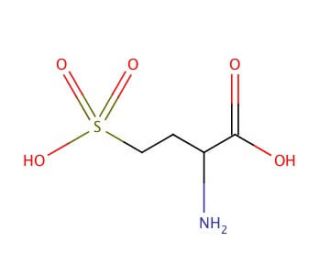

DL-Homocysteic acid (CAS 504-33-6)
QUICK LINKS
DL-Homocysteic acid is a compound that functions as an excitatory amino acid neurotransmitter in the central nervous system. It acts as an agonist at the glutamate receptor, at the N-methyl-D-aspartate (NMDA) receptor subtype. Dl-Homocysteic Acid plays a role in mediating synaptic transmission and plasticity, contributing to the regulation of neuronal development and function. DL-Homocysteic acid modulates the activity of ion channels and influences intracellular signaling pathways, impacting neuronal excitability and synaptic strength. Its mechanism of action involves binding to the NMDA receptor and promoting the influx of calcium ions, which triggers various downstream signaling cascades. Dl-Homocysteic Acid′s interaction with glutamate receptors is integral to the physiological processes underlying learning, memory, and synaptic plasticity in the brain.
DL-Homocysteic acid (CAS 504-33-6) References
- Behavioral and metabolic changes in immature rats during seizures induced by homocysteic acid: the protective effect of NMDA and non-NMDA receptor antagonists. | Folbergrová, J., et al. 2000. Exp Neurol. 161: 336-45. PMID: 10683299
- DL-Homocysteic acid application disrupts calcium homeostasis and induces degeneration of spinal motor neurons in vivo. | Adalbert, R., et al. 2002. Acta Neuropathol. 103: 428-36. PMID: 11935257
- Effect of dl-homocysteic acid on W/O microemulsions of potassium naphthenate/1-octanol-n-heptane. | Zhang, X., et al. 2005. J Colloid Interface Sci. 283: 231-7. PMID: 15694443
- Effect of free radical spin trap N-tert-butyl-alpha-phenylnitrone (PBN) on seizures induced in immature rats by homocysteic acid. | Folbergrová, J., et al. 2006. Exp Neurol. 201: 105-19. PMID: 16756975
- Mitochondrial complex I inhibition in cerebral cortex of immature rats following homocysteic acid-induced seizures. | Folbergrová, J., et al. 2007. Exp Neurol. 204: 597-609. PMID: 17270175
- Modulation of tonic immobility in guinea pig PAG by homocysteic acid, a glutamate agonist. | Ramos Coutinho, M., et al. 2008. Physiol Behav. 94: 468-73. PMID: 18378267
- Influence of microinjections of D,L-homocysteic acid into the Botzinger complex area on the cough reflex in the cat. | Poliacek, I., et al. 2008. J Physiol Pharmacol. 59 Suppl 6: 585-96. PMID: 19218685
- Low-frequency vibrational modes of DL-homocysteic acid and related compounds. | Yang, L., et al. 2009. Spectrochim Acta A Mol Biomol Spectrosc. 73: 884-91. PMID: 19467923
- Sustained deficiency of mitochondrial complex I activity during long periods of survival after seizures induced in immature rats by homocysteic acid. | Folbergrová, J., et al. 2010. Neurochem Int. 56: 394-403. PMID: 19931336
- Oxidative stress in immature brain following experimentally-induced seizures. | Folbergrová, J. 2013. Physiol Res. 62: S39-48. PMID: 24329702
- Cardiorespiratory effects of DL-homocysteic acid in caudal ventrolateral medulla. | Bonham, AC. and Jeske, I. 1989. Am J Physiol. 256: H688-96. PMID: 2646953
- A sensitive UPLC-MS/MS method for simultaneous quantification of one-carbon metabolites & co-factors in human plasma. | Chen, P., et al. 2022. J Pharm Biomed Anal. 219: 114944. PMID: 35863169
- Effect of various analogues of D-glutamic acid on the D-glutamate-adding enzyme from Escherichia coli. | Pratviel-Sosa, F., et al. 1994. FEMS Microbiol Lett. 115: 223-8. PMID: 7908001
Ordering Information
| Product Name | Catalog # | UNIT | Price | Qty | FAVORITES | |
DL-Homocysteic acid, 5 g | sc-257395 | 5 g | $112.00 |