
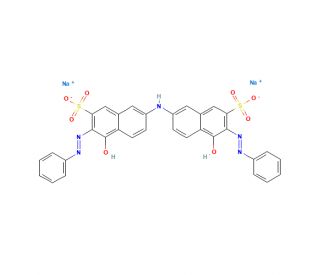

Molecular structure of Direct red 31, CAS Number: 5001-72-9
Direct red 31 (CAS 5001-72-9)
Alternate Names:
7,7′-Iminobis[4-hydroxy-3-(phenylazo)-2-naphthalenesulfonic acid disodium salt
CAS Number:
5001-72-9
Molecular Weight:
713.65
Molecular Formula:
C32H21N5O8S2•2Na
For Research Use Only. Not Intended for Diagnostic or Therapeutic Use.
* Refer to Certificate of Analysis for lot specific data.
QUICK LINKS
Ordering Information
Description
Technical Information
Safety Information
SDS & Certificate of Analysis
Direct Red 31 is a dye that functions as a colorant in experimental applications. It interacts with the molecular structure of the material it is applied to, forming strong covalent bonds with the substrate. This chemical has the ability to bind to specific sites on the material, resulting in a permanent color change. Direct Red 31 achieves this by undergoing a series of chemical reactions with the substrate, leading to the formation of stable, colored complexes. Its mode of action involves the formation of these complexes through a process of electron transfer and bonding, resulting in a vivid and long-lasting coloration of the material.
Direct red 31 (CAS 5001-72-9) References
- Synthesis, characterization and dye removal ability of high capacity polymeric adsorbent: polyaminoimide homopolymer. | Mahmoodi, NM., et al. 2011. J Hazard Mater. 198: 87-94. PMID: 22050931
- Direct dyes removal using modified magnetic ferrite nanoparticle. | Mahmoodi, NM., et al. 2014. J Environ Health Sci Eng. 12: 96. PMID: 24991427
- Self-sustainable Chlorella pyrenoidosa strain NCIM 2738 based photobioreactor for removal of Direct Red-31 dye along with other industrial pollutants to improve the water-quality. | Sinha, S., et al. 2016. J Hazard Mater. 306: 386-394. PMID: 26826964
- Decolorization of azo dyes (Direct Blue 151 and Direct Red 31) by moderately alkaliphilic bacterial consortium. | Lalnunhlimi, S. and Krishnaswamy, V. 2016. Braz J Microbiol. 47: 39-46. PMID: 26887225
- Fabrication of NiFe2O4 magnetic nanoparticles loaded on activated carbon as novel nanoadsorbent for Direct Red 31 and Direct Blue 78 adsorption. | Livani, MJ. and Ghorbani, M. 2018. Environ Technol. 39: 2977-2993. PMID: 28825381
- Efficient removal of dyes using carboxymethyl cellulose/alginate/polyvinyl alcohol/rice husk composite: Adsorption/desorption, kinetics and recycling studies. | Bhatti, HN., et al. 2020. Int J Biol Macromol. 150: 861-870. PMID: 32057879
- Efficient Adsorption of Anionic Dyes by Ammoniated Waste Polyacrylonitrile Fiber: Mechanism and Practicability. | Lei, M., et al. 2021. ACS Omega. 6: 19506-19516. PMID: 34368537
- Improved stability and promoted activity of laccase by One-Pot encapsulation with Cu (PABA) nanoarchitectonics and its application for removal of Azo dyes. | Jiang, S., et al. 2022. Ecotoxicol Environ Saf. 234: 113366. PMID: 35272195
- Adsorption and removal of direct red 31 by Cu-MOF: optimization by response surface. | Li, Z., et al. 2022. Water Sci Technol. 86: 80-94. PMID: 35838284
- Accurate data prediction by fuzzy inference model for adsorption of hazardous azo dyes by novel algal doped magnetic chitosan bionanocomposite. | Solanki, S., et al. 2022. Environ Res. 214: 113844. PMID: 35843281
- Simultaneous removal of Pb2+ and direct red 31 dye from contaminated water using N-(2-hydroxyethyl)-2-oxo-2H-chromene-3-carboxamide loaded chitosan nanoparticles. | El-Naggar, ME., et al. 2022. RSC Adv. 12: 18923-18935. PMID: 35873340
- Corn Cob as a Green Support for Laccase Immobilization-Application on Decolorization of Remazol Brilliant Blue R. | Dos Santos, PM., et al. 2022. Int J Mol Sci. 23: PMID: 36012620
- New insight into the kinetic study on the different loadings of the CuO/CNT catalyst and its optimization for p-chloroaniline photodegradation. | Farahain Binti Khusnun, N., et al. 2022. Nanoscale Adv. 4: 2836-2843. PMID: 36131999
- Self-Supported 3D-Printed Lattices Containing MXene/Metal-Organic Framework (MXOF) Composite as an Efficient Adsorbent for Wastewater Treatment. | Far, HS., et al. 2022. ACS Appl Mater Interfaces. 14: 44488-44497. PMID: 36153953
- Magnetic nanomaterials assisted nanobiocatalysis to abate groundwater pollution. | Parra-Arroyo, L., et al. 2023. MethodsX. 10: 102161. PMID: 37077891
Ordering Information
| Product Name | Catalog # | UNIT | Price | Qty | FAVORITES | |
Direct red 31, 1 g | sc-493235 | 1 g | $206.00 |