
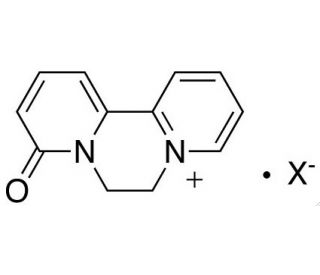

Diquat Monopyridone Bromide (CAS 54016-01-2)
QUICK LINKS
Diquat Monopyridone Bromide (Diquat) is a widely utilized herbicide in agriculture and horticulture for effective weed control. As a non-selective contact herbicide, it acts swiftly upon contact with the foliage of plants, leading to rapid desiccation and subsequent death. Structurally resembling paraquat, another employed herbicide, Diquat Monopyridone Bromide belongs to the pyridine-based compound family. Notably, Diquat Monopyridone Bromide demonstrates lower toxicity compared to paraquat, rendering it a safer option for human usage. Primarily renowned for its herbicidal properties, Diquat Monopyridone Bromide has attracted recent attention in various other realms of research. Studies have exhibited the anti-cancer potential of Diquat Monopyridone Bromide. By activating the p53 pathway, a tumor suppressor pathway, it induces apoptosis (programmed cell death) in cancer cells. Diquat Monopyridone Bromide has demonstrated effectiveness against diverse cancer types, such as breast, lung, and colon cancer. Diquat Monopyridone Bromide also exhibits neuroprotective characteristics by safeguarding neurons against oxidative stress and hindering the formation of toxic protein aggregates associated with neurodegenerative disorders like Alzheimer′s and Parkinson′s disease. Furthermore, it has proven effective in eliminating toxic heavy metals from contaminated soil and water. It forms complexes with heavy metals, facilitating their removal from the environment. Diquat Monopyridone Bromide disrupts the photosynthetic process in plants, entering their cells through stomata and subsequently translocating to the chloroplasts. Within the chloroplasts, it accepts an electron from photosystem I, resulting in the generation of a highly reactive radical that impairs the photosynthetic machinery. In addition, Diquat Monopyridone Bromide can trigger the production of reactive oxygen species (ROS) within plants, leading to potential oxidative damage to cells. The herbicide also disrupts plant cell membranes, which can ultimately result in cell death.
Ordering Information
| Product Name | Catalog # | UNIT | Price | Qty | FAVORITES | |
Diquat Monopyridone Bromide, 100 mg | sc-498690 | 100 mg | $444.00 |