
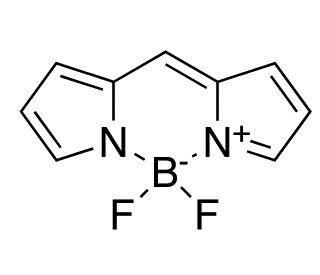

Dipyrrometheneboron difluoride (CAS 138026-71-8)
QUICK LINKS
Dipyrrometheneboron difluoride is a highly versatile and widely used fluorescent dye in scientific research. It serves as a powerful tool for detecting and monitoring various biochemical and physiological processes within living cells, tissues, and organisms. With excellent water solubility and a broad range of absorption and emission wavelengths, this small molecule is highly adaptable. The applications of Dipyrrometheneboron difluoride span multiple fields, including cell biology, biochemistry, and molecular biology. In cell biology, it enables the detection and monitoring of protein, DNA, and RNA expression. In biochemistry, it facilitates the observation of protein-protein and protein-DNA interactions. Molecular biology benefits from its utility in tracking gene expression and other biochemical processes. Operating based on its fluorescence properties, Dipyrrometheneboron difluoride absorbs light and emits light of a distinct wavelength. This emission is harnessed to detect and monitor the ongoing biochemical and physiological processes in cells, tissues, and organisms. By exciting the dye with light and capturing the emitted light using a fluorescent microscope or imaging device, researchers gain valuable insights into the intricate workings of these systems.
Dipyrrometheneboron difluoride (CAS 138026-71-8) References
- The chemistry of fluorescent bodipy dyes: versatility unsurpassed. | Ulrich, G., et al. 2008. Angew Chem Int Ed Engl. 47: 1184-201. PMID: 18092309
- Environment-sensitive behavior of fluorescent molecular rotors. | Haidekker, MA. and Theodorakis, EA. 2010. J Biol Eng. 4: 11. PMID: 20843326
- Dual emission channels for sensitive discrimination of Cys/Hcy and GSH in plasma and cells. | Zhang, Y., et al. 2015. Chem Commun (Camb). 51: 4245-8. PMID: 25670526
- Interaction of fluorescent phospholipids with cyclodextrins. | Denz, M., et al. 2016. Chem Phys Lipids. 194: 37-48. PMID: 26232666
- Hydroxycinnamyl Derived BODIPY as a Lipophilic Fluorescence Probe for Peroxyl Radicals. | Kusio, J., et al. 2020. Antioxidants (Basel). 9: PMID: 31968662
- Polarization-induced charge separation in conjugated microporous polymers for efficient visible light-driven C-3 selenocyanation of indoles. | Xie, Q., et al. 2021. Chem Sci. 12: 5631-5637. PMID: 34163776
- Evaluation of five green fluorescence-emitting streptavidin-conjugated fluorochromes for use in immunofluorescence microscopy. | Benchaib, M., et al. 1996. Histochem Cell Biol. 106: 253-6. PMID: 8877388
- Characterization of dye-induced mobility shifts affecting DNA sequencing in poly(ethylene oxide) sieving matrix. | Tan, H. and Yeung, ES. 1997. Electrophoresis. 18: 2893-900. PMID: 9504827
- Functionalized Calix[4]resorcinarene Cavitands. Versatile Platforms for the Modular Construction of Extended Molecular Switches | Azov Vladimir A., Schlegel Anna, Diederich François. 2006. Bulletin of the Chemical Society of Japan. 79, 12: 1926-1940.
- A selective and sensitive chemosensor for Cu2+ based on 8-hydroxyquinoline | Y Mei, PA Bentley, W Wang. 2006. Tetrahedron Letters. 47, 14: 2447-2449.
- Solvent-dependent photophysical properties of borondipyrromethene dyes in solution | W Qin, T Rohand, M Baruah, A Stefan. 2006. Chemical Physics Letters. 420, 4–6: 562-568.
- Lipid Droplet Formation in Cells of the Filamentous Green Alga Klebsormidium nitens as Revealed by BODIOY-DiOC6 and BODIPY-Nile Red Double-Staining Microscopy | Tsuneyoshi Kuroiwa, Mio Ohnuma, Yuuta Imoto, Haruko Kuroiwa. 2014. CYTOLOGIA. 79 (4): 501-507.
- Development of fluorescent zinc chemosensors based on various fluorophores and their applications in zinc recognition | J Li, C Yin, F Huo. 2016. Dyes and Pigments. 131: 100-133.
Ordering Information
| Product Name | Catalog # | UNIT | Price | Qty | FAVORITES | |
Dipyrrometheneboron difluoride, 250 mg | sc-497243 | 250 mg | $380.00 |