
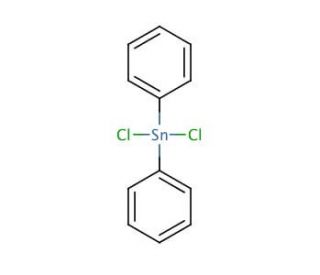

Diphenyltin dichloride (CAS 1135-99-5)
LINK RAPIDI
Il dicloruro di difenilstagno è un composto chimico che funziona come catalizzatore nella sintesi organica. Il suo meccanismo d'azione consiste nel facilitare la formazione di legami carbonio-carbonio e carbonio-eteroatomo attraverso la sua interazione con specifici gruppi funzionali nelle molecole di substrato. Il dicloruro di difenilstagno agisce come un acido di Lewis, favorendo l'attivazione di alcuni legami chimici e consentendo alle reazioni desiderate di procedere in modo efficiente. A livello sperimentale, il dicloruro di difenilstagno svolge un ruolo di promozione della sintesi di vari composti organici, facilitando le fasi chiave di formazione dei legami. Il suo meccanismo d'azione prevede la coordinazione dell'atomo di stagno con gruppi ricchi di elettroni nel substrato, portando all'attivazione di specifici legami chimici e alla successiva formazione di legami. La funzione del dicloruro di difenilstagno nella sintesi organica consiste nella sua capacità di promuovere le trasformazioni chimiche desiderate interagendo con i siti reattivi nelle molecole del substrato.
Diphenyltin dichloride (CAS 1135-99-5) Referenze
- Effetti negativi del dicloruro di difenilstagno sull'inizio e sul mantenimento della gravidanza nei ratti. | Ema, M., et al. 1999. Toxicol Lett. 108: 17-25. PMID: 10472806
- Attività tripanocida dei cloruri organostannici su topi infettati da Trypanosoma brucei. | Shuaibu, MN., et al. 2000. Parasite. 7: 43-5. PMID: 10743647
- La soppressione della decidualizzazione uterina correlata alla riduzione dei livelli sierici di progesterone come causa della perdita embrionale preimpianto indotta dalla difenilstagno nei ratti. | Ema, M. and Miyawaki, E. 2002. Reprod Toxicol. 16: 309-17. PMID: 12128105
- Effetto antiossidativo del kaempferolo e della sua miscela equimolare con composti di fenilstagno su membrane di liposomi irradiati dai raggi UV. | Gabrielska, J., et al. 2005. J Agric Food Chem. 53: 76-83. PMID: 15631512
- Effetti inibitori dei composti di fenilstagno sui cambiamenti indotti dallo stimolo nel calcio libero citosolico e nel potenziale della membrana plasmatica dei neutrofili umani. | Miura, Y. and Matsui, H. 1991. Arch Toxicol. 65: 562-9. PMID: 1664201
- Effetto antiossidativo della quercetina e delle sue miscele equimolari con composti di fenilstagno sulle membrane dei liposomi. | Gabrielska, J., et al. 2006. J Agric Food Chem. 54: 7735-46. PMID: 17002447
- Studi sintetici, strutturali e biochimici di organostannici(IV) con basi di Schiff aventi ligandi donatori di azoto e zolfo. | Singh, HL. and Varshney, AK. 2006. Bioinorg Chem Appl. 2006: 23245. PMID: 17497003
- Comprendere il comportamento molecolare dei composti organostannici per progettarne l'uso efficace come prodotti agrochimici: esplorazione attraverso la chimica quantistica e gli esperimenti. | Ramalho, TC., et al. 2010. J Biomol Struct Dyn. 28: 227-38. PMID: 20645655
- Studi di speciazione di complessi di diorganotina(IV) con 3,3-bis(1-metilimidazol-2-il)propionato - reazione di sostituzione da parte di costituenti del DNA. | Shoukry, MM. and Hassan, SS. 2013. ScientificWorldJournal. 2013: 106357. PMID: 24385867
- Sintesi di polimeri π-coniugati contenenti stannolo mediante trasformazione post-elementare del polimero organotitanio. | Matsumura, Y., et al. 2019. Macromol Rapid Commun. 40: e1800929. PMID: 31150134
- Nuovi candidati farmaci organometallici mirati all'RNA su misura contro le linee cellulari di cancro Huh7 (fegato) e Du145 (prostata). | Khan, HY., et al. 2020. ACS Omega. 5: 15218-15228. PMID: 32637795
- Ciprofloxacina coniugata con difenilstagno(IV): una nuova formulazione con una maggiore attività antimicrobica. | Chrysouli, MP., et al. 2020. Dalton Trans. 49: 11522-11535. PMID: 32656556
- Influenza delle organotine sui meccanismi di aggregazione piastrinica nel ratto. | Knowles, CO. and Johnson, TL. 1986. Environ Res. 39: 172-9. PMID: 3943507
- [Effetto del cloruro di trifenilstagno sulla produzione di superossido (O2-.) nei neutrofili umani]. | Matsui, H., et al. 1984. Sangyo Igaku. 26: 165-9. PMID: 6094890
Informazioni ordini
| Nome del prodotto | Codice del prodotto | UNITÀ | Prezzo | Quantità | Preferiti | |
Diphenyltin dichloride, 5 g | sc-223949 | 5 g | $37.00 | |||
Diphenyltin dichloride, 25 g | sc-223949A | 25 g | $141.00 |