
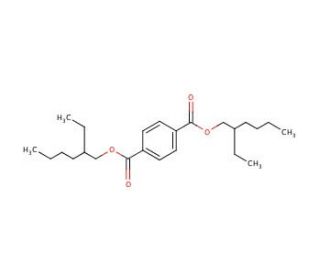

Dioctyl terephthalate (CAS 6422-86-2)
QUICK LINKS
Dioctyl terephthalate, abbreviated as DOTP, is a high-production volume chemical that acts as a plasticizer, widely researched for its ability to impart flexibility to polyvinyl chloride (PVC) resins in the manufacture of a variety of consumer goods. In environmental research, it is studied for its lower ecotoxicity compared to phthalate plasticizers, thus representing a more environmentally friendly alternative for producing flexible plastic materials. The compound′s performance as a plasticizer is also a subject of materials science investigations, where its efficacy in enhancing the durability and longevity of polymers is evaluated. Additionally, Dioctyl terephthalate is involved in research focused on the development of non-toxic and sustainable materials, due to its lack of endocrine-disrupting properties.
Dioctyl terephthalate (CAS 6422-86-2) References
- Biodegradation of plasticizers by Rhodococcus rhodochrous. | Nallii, S., et al. 2002. Biodegradation. 13: 343-52. PMID: 12688586
- Biodegradation of plasticizers by Rhodotorula rubra. | Gartshore, J., et al. 2003. Environ Toxicol Chem. 22: 1244-51. PMID: 12785580
- Construction of an anthropopathic abdominal phantom for accuracy validation of deformable image registration. | Liao, YL., et al. 2016. Technol Health Care. 24 Suppl 2: S717-23. PMID: 27177102
- An anthropomorphic abdominal phantom for deformable image registration accuracy validation in adaptive radiation therapy. | Liao, Y., et al. 2017. Med Phys. 44: 2369-2378. PMID: 28317122
- Characterizing mechanical and medical imaging properties of polyvinyl chloride-based tissue-mimicking materials. | He, Y., et al. 2019. J Appl Clin Med Phys. 20: 176-183. PMID: 31207035
- Immunosuppressive Activities of Novel PLA2 Inhibitors from Xenorhabdus hominickii, an Entomopathogenic Bacterium. | Mollah, MMI., et al. 2020. Insects. 11: PMID: 32759864
- Bacterial community progression during food waste composting containing high dioctyl terephthalate (DOTP) concentration. | Tran, HT., et al. 2021. Chemosphere. 265: 129064. PMID: 33248736
- Phthalate and novel plasticizer concentrations in food items from U.S. fast food chains: a preliminary analysis. | Edwards, L., et al. 2022. J Expo Sci Environ Epidemiol. 32: 366-373. PMID: 34702987
- Empirical correlations for diffusivity and the partition coefficient for phthalates in PVC materials and modelling emissions of automotive sealants. | Gilliam, MA., et al. 2022. Chemosphere. 294: 133638. PMID: 35085611
- The Xenopus laevis teratogenesis assay for developmental toxicity of phthalate plasticizers and alternatives. | Xu, Y., et al. 2022. Environ Pollut. 300: 118985. PMID: 35167930
- Effects of Lactobacillus plantarum and Saccharomyces cerevisiae co-fermentation on the structure and flavor of wheat noodles. | Ge, Z., et al. 2022. J Sci Food Agric. 102: 4697-4706. PMID: 35191031
- Synthesis and properties of castor oil based plasticizers. | Fu, Q., et al. 2019. RSC Adv. 9: 10049-10057. PMID: 35520945
- Effects of time, temperature, and sebum layer on migration rate of plasticizers in polyvinyl chloride products. | Kim, DY., et al. 2022. Chemosphere. 308: 136478. PMID: 36122749
Ordering Information
| Product Name | Catalog # | UNIT | Price | Qty | FAVORITES | |
Dioctyl terephthalate, 1 L | sc-234771 | 1 L | $57.00 |