
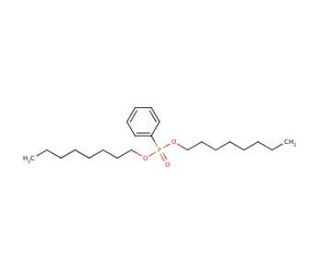

Dioctyl phenylphosphonate (CAS 1754-47-8)
QUICK LINKS
Dioctyl phenylphosphonate (DOPP) is an organophosphonate compound widely employed in various applications, including its use as a flame retardant, plasticizer, and surfactant. This colorless and odorless liquid demonstrates solubility in water while maintaining its chemical stability and non-toxic nature. Its versatility is evident in its incorporation as a common ingredient in an array of consumer products like adhesives, sealants, coatings, and lubricants. Furthermore, Dioctyl phenylphosphonate plays a significant role in industrial processes, specifically in the production of polymers, plastics, and rubber. Beyond its practical applications, Dioctyl phenylphosphonate has served as a valuable research tool within scientific investigations. Scientists have leveraged its properties to explore the impact of organophosphonates on protein and enzyme metabolism, as well as to unravel the mechanisms by which organophosphonates affect cellular processes. Moreover, researchers have utilized Dioctyl phenylphosphonate to investigate its effects on the structure and functionality of proteins and enzymes. The mode of action of Dioctyl phenylphosphonate involves its binding to proteins and enzymes, resulting in the inhibition of their activity. This binding event induces a conformational change within these biomolecules, leading to alterations in their structure and function.
Dioctyl phenylphosphonate (CAS 1754-47-8) References
- Study of sweet taste evaluation using taste sensor with lipid/polymer membranes. | Habara, M., et al. 2004. Biosens Bioelectron. 19: 1559-63. PMID: 15142588
- Flow-through chloroquine sensor and its applications in pharmaceutical analysis. | Saad, B., et al. 2005. Anal Sci. 21: 521-4. PMID: 15913140
- Amodiaquine polymeric membrane electrode. | Malongo, TK., et al. 2006. J Pharm Biomed Anal. 41: 70-6. PMID: 16303276
- PVC membrane based potentiometric sensors for uranium determination. | Hassan, SS., et al. 2001. Talanta. 54: 1153-61. PMID: 18968336
- Development and evaluation of a miniaturized taste sensor chip. | Tahara, Y., et al. 2011. Sensors (Basel). 11: 9878-86. PMID: 22163731
- Ionophore-based potentiometric sensors for the flow-injection determination of promethazine hydrochloride in pharmaceutical formulations and human urine. | Hassan, AK., et al. 2011. Sensors (Basel). 11: 1028-42. PMID: 22346617
- Disposable E-Tongue for the Assessment of Water Quality in Fish Tanks. | Chang, CC., et al. 2008. Sensors (Basel). 8: 3665-3677. PMID: 27879900
- The Utility of the Artificial Taste Sensor in Evaluating the Bitterness of Drugs: Correlation with Responses of Human TASTE2 Receptors (hTAS2Rs). | Haraguchi, T., et al. 2018. Chem Pharm Bull (Tokyo). 66: 71-77. PMID: 29311514
- A Broad-Spectrum Sweet Taste Sensor Based on Ni(OH)₂/Ni Electrode. | Mao, Y., et al. 2018. Sensors (Basel). 18: PMID: 30135351
- Organophosphate Ester Flame Retardants: Are They a Regrettable Substitution for Polybrominated Diphenyl Ethers? | Blum, A., et al. 2019. Environ Sci Technol Lett. 6: 638-649. PMID: 32494578
- Analysis of Milk Using a Portable Potentiometric Electronic Tongue Based on Five Polymeric Membrane Sensors. | Pérez-González, C., et al. 2021. Front Chem. 9: 706460. PMID: 34291037
- Rapid electrochemical sensor for uranium(vi) assessment in aqueous media. | Akl, ZF. 2022. RSC Adv. 12: 20147-20155. PMID: 35919617
- Development and Optimization of a Highly Sensitive Sensor to Quinine-Based Saltiness Enhancement Effect. | Jing, Y., et al. 2023. Sensors (Basel). 23: PMID: 36991892
- Theory of electric characteristics of the lipid/PVC/DOPP membrane and PVC/DOPP membrane in response to taste stimuli. | Oohira, K. and Toko, K. 1996. Biophys Chem. 61: 29-35. PMID: 8855357
Ordering Information
| Product Name | Catalog # | UNIT | Price | Qty | FAVORITES | |
Dioctyl phenylphosphonate, 25 ml | sc-252745 | 25 ml | $145.00 |