
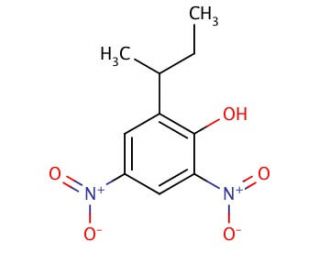

Dinoseb (CAS 88-85-7)
QUICK LINKS
Dinoseb is potentially toxic. Its toxicity stems from its capability to stimulate oxidative metabolism in cell mitochondria by interfering with the normal coupling of carbohydrate oxidation to phosphorylation. This increased oxidative metabolism can lead to fever, increased heart rate, and dehydration, and could ultimately deplete carbohydrate and fat stores. Dinoseb has been found to be relatively ineffective as an inhibitor of electron transfer reactions in the photosynthetic bacterium, Rhodopseudomonas sphaeroides. When administered to rats, derivatives of 2,4-dinitrophenol can affect the electron transport system, inhibit energy metabolism, and decrease the detoxification system of the liver. Dinoseb is thought to enhance metabolic activity by uncoupling oxidative phosphorylation and disrupting adenosine triphosphate synthesis, which could potentially result in hyperthermia. In ruminants, Dinoseb can be reduced to an amine, possibly leading to the oxidation of hemoglobin to methemoglobin.
Dinoseb (CAS 88-85-7) References
- Study of nitrophenols preconcentration using quinolin-8-ol immobilized on controlled-pore glass in the presence of iron(III). Chromatographic determination of dinoseb in lemon juice. | Fernández-Salinero, G., et al. 1999. J Chromatogr A. 839: 227-32. PMID: 10327627
- Effects of dinoseb, 4,6-dinitro-o-cresol, and 2,4-dinitrophenol on rat Sertoli-germ cell co-cultures. | Takahashi, KL., et al. 2003. Reprod Toxicol. 17: 247-52. PMID: 12642158
- Differential pulse adsorptive stripping voltammetric determination of dinoseb and dinoterb at a modified electrode. | Sreedhar, M., et al. 2003. Anal Sci. 19: 511-6. PMID: 12725384
- Comparative studies on the spermatotoxic effects of dinoseb and its structurally related chemicals. | Takahashi, KL., et al. 2004. Reprod Toxicol. 18: 581-8. PMID: 15135852
- Toxic actions of dinoseb in medaka (Oryzias latipes) embryos as determined by in vivo 31P NMR, HPLC-UV and 1H NMR metabolomics. | Viant, MR., et al. 2006. Aquat Toxicol. 76: 329-42. PMID: 16290222
- Evidence for a novel quinone-binding site in the photosystem II (PS II) complex that regulates the redox potential of cytochrome b559. | Kaminskaya, O., et al. 2007. Biochemistry. 46: 1091-105. PMID: 17240992
- Review of developmental toxicity of nitrophenolic herbicide dinoseb, 2-sec-butyl-4,6-dinitrophenol. | Matsumoto, M., et al. 2008. Reprod Toxicol. 25: 327-34. PMID: 18462922
- Small-scale spatial variability of atrazine and dinoseb adsorption parameters in an alluvial soil. | Mermoud, A., et al. 2008. J Environ Qual. 37: 1929-36. PMID: 18689754
- Review of testicular toxicity of dinitrophenolic compounds, 2-sec-butyl-4,6-dinitrophenol, 4,6-dinitro-o-cresol and 2,4-dinitrophenol. | Matsumoto, M., et al. 2008. Reprod Toxicol. 26: 185-90. PMID: 18926899
- Remediating dinoseb-contaminated soil with zerovalent iron. | Satapanajaru, T., et al. 2009. J Hazard Mater. 168: 930-7. PMID: 19345492
- Prenatal developmental toxicity of gavage or feeding doses of 2-sec-butyl-4,6-dinitrophenol in rats. | Matsumoto, M., et al. 2010. Reprod Toxicol. 29: 292-7. PMID: 20132881
- (RS)-Dimethyl-ammonium 2-sec-butyl-4,6-dinitro-phenolate. | Görbitz, CH. 2009. Acta Crystallogr Sect E Struct Rep Online. 65: o2630. PMID: 21578246
- Assaying embryotoxicity in the test tube: current limitations of the embryonic stem cell test (EST) challenging its applicability domain. | Riebeling, C., et al. 2012. Crit Rev Toxicol. 42: 443-64. PMID: 22512667
- Photodegradation of two dinitrophenolic pesticide chemicals, dinobuton and dinoseb, applied to bean leaves. | Matsuo, H. and Casida, JE. 1970. Bull Environ Contam Toxicol. 5: 72-8. PMID: 24185730
- In vitro neurotoxic hazard characterisation of dinitrophenolic herbicides. | Heusinkveld, HJ., et al. 2016. Toxicol Lett. 252: 62-9. PMID: 27106277
Ordering Information
| Product Name | Catalog # | UNIT | Price | Qty | FAVORITES | |
Dinoseb, 100 mg | sc-257368 | 100 mg | $75.00 |