
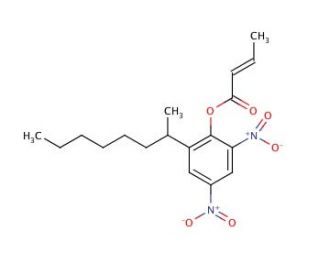

Dinocap (CAS 39300-45-3)
QUICK LINKS
Dinocap is a widely used insecticide It belongs to the organophosphate family and has been utilized since the 1950s with continued global usage. Not only is Dinocap popular in practical farming, but it also holds significance in scientific research. It serves as an insecticide in studies related to insect physiology, biochemistry, behavior, as well as investigating the impact of insecticides on insect populations and plant growth. The mode of action of Dinocap involves disrupting the normal functioning of the insect′s nervous system. By binding to the insect′s nerve cells, it hinders the transmission of nerve impulses, leading to paralysis and eventual death of the insect. Furthermore, Dinocap influences the insect′s metabolism, rendering it incapable of producing energy.
Dinocap (CAS 39300-45-3) References
- Assessment of the immunotoxic potential of the fungicide dinocap in mice. | Smialowicz, RJ., et al. 1992. Toxicology. 75: 235-47. PMID: 1455432
- Interspecies comparisons of A/D ratios: A/D ratios are not constant across species. | Daston, GP., et al. 1991. Fundam Appl Toxicol. 17: 696-722. PMID: 1843185
- Effects of fungicides mancozeb and dinocap on carbon and nitrogen mineralization in soils. | Černohlávková, J., et al. 2009. Ecotoxicol Environ Saf. 72: 80-85. PMID: 18755509
- Effect of fungicides and of biocontrol agents against powdery mildew of turnip. | Gilardi, G., et al. 2008. Commun Agric Appl Biol Sci. 73: 21-9. PMID: 19226738
- Effects of dinocap on otolith development: evaluation of mouse and hamster fetuses at term. | Rogers, JM., et al. 1989. Teratology. 39: 515-23. PMID: 2772841
- Prenatal exposure to the fungicide dinocap causes behavioral torticollis, ballooning and cleft palate in mice, but not rats or hamsters. | Gray, LE., et al. 1986. Teratog Carcinog Mutagen. 6: 33-43. PMID: 2874635
- Teratogenic effects of the fungicide dinocap in the mouse. | Rogers, JM., et al. 1986. Teratog Carcinog Mutagen. 6: 375-81. PMID: 2878503
- Developmental toxicity of dinocap in the mouse is not due to two isomers of the major active ingredients. | Rogers, JM., et al. 1987. Teratog Carcinog Mutagen. 7: 341-6. PMID: 2888213
- Human exposure to banned pesticides reported to the French Poison Control Centers: 2012-2016. | Boucaud-Maitre, D., et al. 2019. Environ Toxicol Pharmacol. 69: 51-56. PMID: 30953934
- Persistence and dissipation study of azoxystrobin, buprofezin, dinocap and hexaconazole on mango (Mangifera indica L.). | Mohapatra, S., et al. 2020. Environ Sci Pollut Res Int. 27: 32820-32828. PMID: 32519101
- Prenatal dinocap exposure alters swimming behavior in mice due to complete otolith agenesis in the inner ear. | Gray, LE., et al. 1988. Toxicol Appl Pharmacol. 92: 266-73. PMID: 3341037
- The mouse teratogen dinocap has lower A/D ratios and is not teratogenic in the rat and hamster. | Rogers, JM., et al. 1988. Teratology. 37: 553-9. PMID: 3400070
- A review of the acceptable daily intakes of pesticides assessed by WHO. | Lu, FC. 1995. Regul Toxicol Pharmacol. 21: 352-64. PMID: 7480888
Ordering Information
| Product Name | Catalog # | UNIT | Price | Qty | FAVORITES | |
Dinocap, 250 mg | sc-234768 | 250 mg | $136.00 |