
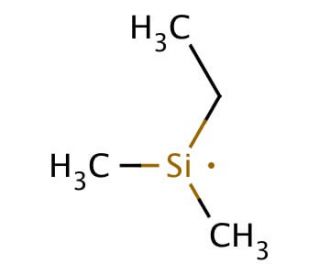

Molecular structure of Dimethylethylsilane, CAS Number: 758-21-4
Dimethylethylsilane (CAS 758-21-4)
Alternate Names:
Ethyldimethylsilane
CAS Number:
758-21-4
Molecular Weight:
88.22
Molecular Formula:
C4H12Si
Supplemental Information:
This is as a Dangerous Good for transport and may be subject to additional shipping charges.
For Research Use Only. Not Intended for Diagnostic or Therapeutic Use.
* Refer to Certificate of Analysis for lot specific data.
QUICK LINKS
Ordering Information
Description
Technical Information
Safety Information
SDS & Certificate of Analysis
Dimethylethylsilane is a silane compound. It is involved in the synthesis of various organic compounds and has ability to facilitate the formation of carbon-carbon bonds. Dimethylethylsilane is used as a reagent in organic reactions, where it can act as a source of carbon nucleophiles. Dimethylethylsilane is an effective reagent for the introduction of alkyl groups into organic molecules, further expanding its utility in biochemistry. Its role in the formation of carbon-carbon bonds and alkyl group introduction makes dimethylethylsilane an important component in the toolkit of biochemists.
Dimethylethylsilane (CAS 758-21-4) References
- Synthesis of ethylene oxide/methyl methacrylate diblock copolymers by group transfer polymerization of methyl methacrylate with poly (ethylene oxide) macroinitiators | Budde, H., & Höring, S. Macromolecular Chemistry and Physics. 199(11): 2541-2546.
- A novel B(C(6)F(5))(3)-catalyzed reduction of alcohols and cleavage of aryl and alkyl ethers with hydrosilanes. | Gevorgyan, V., et al. 2000. J Org Chem. 65: 6179-86. PMID: 10987957
- A triruthenium carbonyl cluster bearing a bridging acenaphthylene ligand: an efficient catalyst for reduction of esters, carboxylic acids, and amides by trialkylsilanes. | Matsubara, K., et al. 2002. J Org Chem. 67: 4985-8. PMID: 12098320
- In situ generation and trapping of aryllithium and arylpotassium species by halogen, sulfur, and carbon electrophiles. | Popov, I., et al. 2009. J Org Chem. 74: 8309-13. PMID: 19827765
- Hydrosilation of Carbonyl-Containing Substrates Catalyzed by an Electrophilic η-Silane Iridium(III) Complex. | Park, S. and Brookhart, M. 2010. Organometallics. 29: 6057-6064. PMID: 21572562
- Ligand-free Ni-catalyzed reductive cleavage of inert carbon-sulfur bonds. | Barbero, N. and Martin, R. 2012. Org Lett. 14: 796-9. PMID: 22256952
- Metastable and collision-induced fragmentation studies of all C4H 12Si (+) isomers; a systematic study of structure-reactivity relations. | Saulys, DA., et al. 1994. J Am Soc Mass Spectrom. 5: 537-43. PMID: 24222621
- Facile production of stable silicon nanoparticles: laser chemistry coupled to in situ stabilization via room temperature hydrosilylation. | Malumbres, A., et al. 2015. Nanoscale. 7: 8566-73. PMID: 25898392
- A Nickel-Doped Dehydrobenzoannulene-Based Two-Dimensional Covalent Organic Framework for the Reductive Cleavage of Inert Aryl C-S Bonds. | Haug, WK., et al. 2020. J Am Chem Soc. 142: 5521-5525. PMID: 32163282
- Low-temperature epitaxial growth of cubic SiC thin films on Si (111) using supersonic molecular jet of single source precursors | Boo, J. H., Ustin, S. A., & Ho, W. 1999. Thin Solid Films. 343: 650-655.
- Analysis of the NMR spectra of some dimethylsilanes | Bain, A. D., Brook, M. A., Hazendonk, P., Reid, D., & Stan, R. S. 2000. Magnetic Resonance in Chemistry. 38(10): 894-895.
- Development, synthetic scope, and mechanistic studies of the palladium-catalyzed cycloisomerization of functionalized 1, 6-dienes in the presence of silane | Kisanga, P., & Widenhoefer, R. A. 2000. Journal of the American Chemical Society. 122(41): 10017-10026.
- Metal Trifluoromethanesulfonate‐Catalyzed Regioselective Reductive Ring Opening of Benzylidene Acetals | Shie, C. R., Tzeng, Z. H., Wang, C. C., & Hung, S. C. 2009. Journal of the Chinese Chemical Society. 56(3): 510-523.
Ordering Information
| Product Name | Catalog # | UNIT | Price | Qty | FAVORITES | |
Dimethylethylsilane, 5 g | sc-257365 | 5 g | $102.00 |