
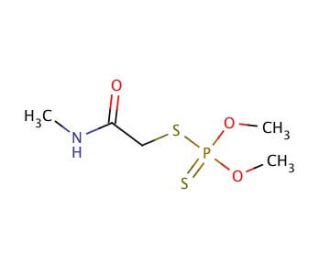

Dimethoate (CAS 60-51-5)
QUICK LINKS
Dimethoate is an anticholinesterase which disables cholinesterase, an enzyme essential for central nervous system function. It is an organophosphate pesticide that is acaricidal against Kanzawa spider mites. It acts as a contact and systemic insecticide effective against a broad range of insects and mites when applied on a wide range of crops. Dimethoate (50-200 μM) reduces motility and viability and induces abnormal morphology of rat sperm. It also increases production of malondialdehyde (MDA) and reduces superoxide dismutase (SOD), catalase (CAT), and glutathione peroxidase (Gpx) activities in rat epididymal sperm. Dimethoate also induces formation of carcinomas in the adrenal, thyroid, and pituitary glands of male and female rats as well as testicular atrophy, chronic renal disease, polyarteritis, and parathyroid hyperplasia in male rats.
Dimethoate (CAS 60-51-5) References
- Acute Toxicity of Fresh and Aged Residues of Pesticides to the Parasitoid Tamarixia radiata and to the HLB-Bacteria Vector Diaphorina citri. | Beloti, VH., et al. 2018. Neotrop Entomol. 47: 403-411. PMID: 29222706
- Assessment of the dissipation, pre-harvest interval and dietary risk of carbosulfan, dimethoate, and their relevant metabolites in greenhouse cucumber (Cucumis sativus L.). | Geng, Y., et al. 2018. Pest Manag Sci. 74: 1654-1663. PMID: 29327491
- Characterization and risk assessment of seasonal and weather dynamics in organic pollutant mixtures from discharge of a separate sewer system. | Beckers, LM., et al. 2018. Water Res. 135: 122-133. PMID: 29466716
- Antioxidant enzyme responses to the oxidative stress due to chlorpyrifos, dimethoate and dieldrin stress in palak (Spinacia oleracea L.) and their toxicity alleviation by soil amendments in tropical croplands. | Singh, P. and Prasad, SM. 2018. Sci Total Environ. 630: 839-848. PMID: 29499539
- A magnetic controllable tool for the selective enrichment of dimethoate from olive oil samples: A responsive molecular imprinting-based approach. | Garcia, R., et al. 2018. Food Chem. 254: 309-316. PMID: 29548458
- Effects of light, microorganisms, farming chemicals and water content on the degradation of microcystin-LR in agricultural soils. | Cao, Q., et al. 2018. Ecotoxicol Environ Saf. 156: 141-147. PMID: 29549737
- Assessment of neurohepatic DNA damage in male Sprague-Dawley rats exposed to organophosphates and pyrethroid insecticides. | Yahia, D. and Ali, MF. 2018. Environ Sci Pollut Res Int. 25: 15616-15629. PMID: 29572745
- Synthesis and application of molecularly imprinted silica for the selective extraction of some polar organophosphorus pesticides from almond oil. | Boulanouar, S., et al. 2018. Anal Chim Acta. 1018: 35-44. PMID: 29605132
- Chronic toxicity of amitraz, coumaphos and fluvalinate to Apis mellifera L. larvae reared in vitro. | Dai, P., et al. 2018. Sci Rep. 8: 5635. PMID: 29618776
- Six months exposure to a real life mixture of 13 chemicals' below individual NOAELs induced non monotonic sex-dependent biochemical and redox status changes in rats. | Docea, AO., et al. 2018. Food Chem Toxicol. 115: 470-481. PMID: 29621577
- Gold-nanoparticle-based fluorescent 'turn-on' sensor for selective and sensitive detection of dimethoate. | Hung, SH., et al. 2018. Food Chem. 260: 61-65. PMID: 29699682
- RETRACTED:Insecticide exposure affects DNA and antioxidant enzymes activity in honey bee species Apis florea and A. dorsata: Evidence from Punjab, Pakistan. | Hayat, K., et al. 2018. Sci Total Environ. 635: 1292-1301. PMID: 29710582
- Photocatalytic degradation of dimethoate in Bok choy using cerium-doped nano titanium dioxide. | Liu, X., et al. 2018. PLoS One. 13: e0197560. PMID: 29771967
- Pesticide residues in honey bees, pollen and beeswax: Assessing beehive exposure. | Calatayud-Vernich, P., et al. 2018. Environ Pollut. 241: 106-114. PMID: 29803024
- Assessment of genetic diversity and bioremediation potential of pseudomonads isolated from pesticide-contaminated artichoke farm soils. | Hassen, W., et al. 2018. 3 Biotech. 8: 263. PMID: 29805953
Ordering Information
| Product Name | Catalog # | UNIT | Price | Qty | FAVORITES | |
Dimethoate, 100 mg | sc-257353 | 100 mg | $100.00 | |||
Dimethoate, 1 g | sc-257353A | 1 g | $683.00 |