
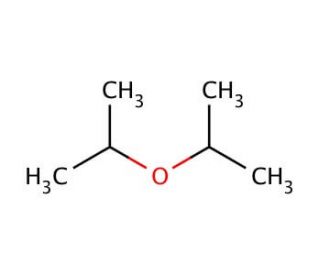

Molecular structure of Diisopropyl ether, CAS Number: 108-20-3
Diisopropyl ether (CAS 108-20-3)
Alternate Names:
Isopropyl ether
CAS Number:
108-20-3
Molecular Weight:
102.17
Molecular Formula:
C6H14O
Supplemental Information:
This is classified as a Dangerous Good for transport and may be subject to additional shipping charges.
For Research Use Only. Not Intended for Diagnostic or Therapeutic Use.
* Refer to Certificate of Analysis for lot specific data.
QUICK LINKS
Ordering Information
Description
Technical Information
Safety Information
SDS & Certificate of Analysis
Diisopropyl ether (DIPE) is a common volatile compound employed in a variety of applications, including as a reaction medium, a reagent, and a solvent for a variety of organic compounds. It can influence reaction rates, product selectivity, and solubility of reagents. In the laboratory, Diisopropyl ether can be used for liquid-liquid extraction, helping in the separation of organic compounds from aqueous mixtures. It has also been used in the synthesis of agrochemicals, in the study of the mechanism of action of enzymes and other proteins, and in the study of the structure and properties of organic compounds.
Diisopropyl ether (CAS 108-20-3) References
- A kinetic model for enzyme interfacial activity and stability: pa-hydroxynitrile lyase at the diisopropyl ether/water interface. | Cascão Pereira, LG., et al. 2002. Biotechnol Bioeng. 78: 595-605. PMID: 11992525
- Molecular interaction study of the diisopropyl ether-propionic acid mixture by spectroscopic and dielectric studies. | Arivazhagan, G., et al. 2011. Spectrochim Acta A Mol Biomol Spectrosc. 81: 172-7. PMID: 21733745
- Health assessment of gasoline and fuel oxygenate vapors: developmental toxicity in rats. | Roberts, LG., et al. 2014. Regul Toxicol Pharmacol. 70: S69-79. PMID: 24845242
- Health assessment of gasoline and fuel oxygenate vapors: neurotoxicity evaluation. | O'Callaghan, JP., et al. 2014. Regul Toxicol Pharmacol. 70: S35-42. PMID: 24879970
- Health assessment of gasoline and fuel oxygenate vapors: subchronic inhalation toxicity. | Clark, CR., et al. 2014. Regul Toxicol Pharmacol. 70: S18-28. PMID: 25020274
- Permitted Daily Exposure for Diisopropyl Ether as a Residual Solvent in Pharmaceuticals. | Romanelli, L. and Evandri, MG. 2018. Toxicol Res. 34: 111-125. PMID: 29686773
- Draft Genome Sequence of Mycolicibacterium sp. Strain CH28, a Potential Degrader of Diisopropyl Ether, Isolated from Pharmaceutical Wastewater. | Zsilinszky, I., et al. 2019. Microbiol Resour Announc. 8: PMID: 31515342
- Synchrotron Photoionization Study of the Diisopropyl Ether Oxidation. | Giustini, A. and Meloni, G. 2020. Chemphyschem. 21: 927-937. PMID: 32078232
- Exposure Profile to Traffic Related Pollution in Pediatric Age: A Biomonitoring Study. | Antonucci, A., et al. 2021. Int J Environ Res Public Health. 18: PMID: 34639421
- Enhanced Isopropyl Alcohol Conversion over Acidic Nickel Phosphate-Supported Zeolite Catalysts. | Hasanudin, H., et al. 2022. ACS Omega. 7: 38923-38932. PMID: 36340067
- Retention of gangliosides in serum delipidated by diisopropyl ether-1-butanol extraction. | Wong, CG. and Ladisch, S. 1983. J Lipid Res. 24: 666-9. PMID: 6875392
- Safety in the SEM laboratory--1981 update. | Bance, GN., et al. 1981. Scan Electron Microsc. 87-94. PMID: 7034181
- Subchronic and developmental toxicity studies of vaporized diisopropyl ether in rats. | Dalbey, W. and Feuston, M. 1996. J Toxicol Environ Health. 49: 29-43. PMID: 8816932
Ordering Information
| Product Name | Catalog # | UNIT | Price | Qty | FAVORITES | |
Diisopropyl ether, 1 L | sc-239760 | 1 L | $165.00 |