
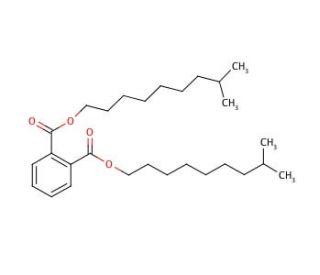

Molecular structure of Diisodecyl phthalate, CAS Number: 26761-40-0
Diisodecyl phthalate (CAS 26761-40-0)
Alternate Names:
DIDP
Application:
Diisodecyl phthalate is a plasticizer for membrane electrodes
CAS Number:
26761-40-0
Purity:
≥99%
Molecular Weight:
446.66
Molecular Formula:
C28H46O4
Supplemental Information:
This is classified as a Dangerous Good for transport and may be subject to additional shipping charges.
For Research Use Only. Not Intended for Diagnostic or Therapeutic Use.
* Refer to Certificate of Analysis for lot specific data.
QUICK LINKS
Ordering Information
Description
Technical Information
Safety Information
SDS & Certificate of Analysis
Diisodecyl phthalate is a clear, colorless to pale yellow liquid that is insoluble in water. Frequently used as a plasticizer in many industrial sectors, it enhances the pliability, longevity, and suppleness of numerous polymers, notably those based on PVC. It′s integral to the production of items like pipes, cables, and floor materials. The detection of this compound is achieved through dispersing solid-phase extraction using polyvinylpyrrolidone (PVP). A plasticizer for PVC membrane electrodes.
Diisodecyl phthalate (CAS 26761-40-0) References
- Human biological monitoring of diisononyl phthalate and diisodecyl phthalate: a review. | Saravanabhavan, G. and Murray, J. 2012. J Environ Public Health. 2012: 810501. PMID: 22505951
- Effects of Diisodecyl Phthalate on PPAR:RXR-Dependent Gene Expression Pathways in Sea Bream Hepatocytes. | Cocci, P., et al. 2015. Chem Res Toxicol. 28: 935-47. PMID: 25825955
- Oral exposure to diisodecyl phthalate aggravates allergic dermatitis by oxidative stress and enhancement of thymic stromal lymphopoietin. | Shen, S., et al. 2017. Food Chem Toxicol. 99: 60-69. PMID: 27871981
- Exposure to diisodecyl phthalate exacerbated Th2 and Th17-mediated asthma through aggravating oxidative stress and the activation of p38 MAPK. | Qin, W., et al. 2018. Food Chem Toxicol. 114: 78-87. PMID: 29448086
- Diisodecyl phthalate aggravates the formaldehyde-exposure-induced learning and memory impairment in mice. | Ge, S., et al. 2019. Food Chem Toxicol. 126: 152-161. PMID: 30790713
- Hepatic and renal tissue damage in Balb/c mice exposed to diisodecyl phthalate: The role of oxidative stress pathways. | Chen, Y., et al. 2019. Food Chem Toxicol. 132: 110600. PMID: 31228599
- Biochemical and behavior effects induced by diheptyl phthalate (DHpP) and Diisodecyl phthalate (DIDP) exposed to zebrafish. | Poopal, RK., et al. 2020. Chemosphere. 252: 126498. PMID: 32197170
- Effects of in utero exposure to diisodecyl phthalate on fetal testicular cells in rats. | Zhang, S., et al. 2020. Toxicol Lett. 330: 23-29. PMID: 32387388
- Plasticization of a Semicrystalline Metallosupramolecular Polymer Network. | Marx, F., et al. 2023. ACS Polym Au. 3: 132-140. PMID: 36785838
- Bringing sex toys out of the dark: exploring unmitigated risks. | Sipe, JM., et al. 2023. Microplast nanoplast. 3: 6. PMID: 36974201
- Occurrence of phthalates in different food matrices: A systematic review of the main sources of contamination and potential risks. | da Costa, JM., et al. 2023. Compr Rev Food Sci Food Saf. 22: 2043-2080. PMID: 36988015
- Evaluation of Surface Properties and Separation Performance of NF and RO Membranes for Phthalates Removal. | Lim, EQ., et al. 2023. Membranes (Basel). 13: PMID: 37103840
- The Relationship between Phthalates and Diabetes: A Review. | Mariana, M. and Cairrao, E. 2023. Metabolites. 13: PMID: 37367903
Activator of:
DBP.Ordering Information
| Product Name | Catalog # | UNIT | Price | Qty | FAVORITES | |
Diisodecyl phthalate, 10 ml | sc-255101 | 10 ml | $94.00 |