
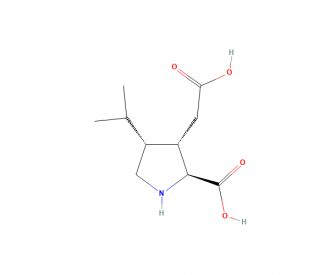

Molecular structure of Dihydrokainic acid, CAS Number: 52497-36-6
Dihydrokainic acid (CAS 52497-36-6)
See product citations (3)
Alternate Names:
2-Carboxy-4-isopropyl-3-pyrrolidineacetic acid
Application:
Dihydrokainic acid is an EAAT2(GLT1)-selective non-transportable inhibitor of L-glutamate and L-aspartate uptake
CAS Number:
52497-36-6
Molecular Weight:
215.30
Molecular Formula:
C10H17NO4
For Research Use Only. Not Intended for Diagnostic or Therapeutic Use.
* Refer to Certificate of Analysis for lot specific data.
QUICK LINKS
Ordering Information
Product Citations
Description
Technical Information
Safety Information
SDS & Certificate of Analysis
Dihydrokainic acid is an EAAT2 (GLT1)-selective non-transportable inhibitor of L-glutamate and L-aspartate uptake (Ki = 23 μM). Dihydrokainic acid is 130-fold selective over EAAT1 and EAAT3 (Ki > 3 mM). GLT-1 is a key component of the regulation of glutamate neurotransmission. By modulating the activity of GLT-1, dihydrokainic acid allows the exploration of the mechanisms of glutamate uptake and how they affect neuronal activity. This compound′s ability to influence glutamate dynamics makes it instrumental in research focused on understanding neuronal communication, plasticity, and the role of glutamate.
Dihydrokainic acid (CAS 52497-36-6) References
- Kainate receptors and synaptic transmission. | Huettner, JE. 2003. Prog Neurobiol. 70: 387-407. PMID: 14511698
- CB1 cannabinoid receptors and on-demand defense against excitotoxicity. | Marsicano, G., et al. 2003. Science. 302: 84-8. PMID: 14526074
- Activated microglia initiate motor neuron injury by a nitric oxide and glutamate-mediated mechanism. | Zhao, W., et al. 2004. J Neuropathol Exp Neurol. 63: 964-77. PMID: 15453095
- Glial glutamate transporter 1 regulates the spatial and temporal coding of glutamatergic synaptic transmission in spinal lamina II neurons. | Weng, HR., et al. 2007. Neuroscience. 149: 898-907. PMID: 17935889
- Aquaporin-4 deficiency attenuates opioid dependence through suppressing glutamate transporter-1 down-regulation and maintaining glutamate homeostasis. | Yan, HT., et al. 2013. CNS Neurosci Ther. 19: 12-9. PMID: 23051665
- Valproate prevents dysregulation of spinal glutamate and reduces the development of hypersensitivity in rats after peripheral nerve injury. | Yoshizumi, M., et al. 2013. J Pain. 14: 1485-91. PMID: 24021575
- Bupivacaine Indirectly Potentiates Glutamate-induced Intracellular Calcium Signaling in Rat Hippocampal Neurons by Impairing Mitochondrial Function in Cocultured Astrocytes. | Xing, Y., et al. 2018. Anesthesiology. 128: 539-554. PMID: 29232206
- Glutamate transporter GLT1 inhibitor dihydrokainic acid impairs novel object recognition memory performance in mice. | Tian, SW., et al. 2019. Physiol Behav. 199: 28-32. PMID: 30389478
- Kainic acid: a powerful neurotoxic analogue of glutamate. | Olney, JW., et al. 1974. Brain Res. 77: 507-12. PMID: 4152936
- Excitatory amino acid transmitters. | Watkins, JC. and Evans, RH. 1981. Annu Rev Pharmacol Toxicol. 21: 165-204. PMID: 6112965
- Kainic acid stimulates excitatory amino acid neurotransmitter release at presynaptic receptors. | Ferkany, JW., et al. 1982. Nature. 298: 757-9. PMID: 6287270
- Glycine-induced CA1 excitotoxicity in the rat hippocampal slice. | Wallis, RA., et al. 1995. Brain Res. 685: 115-25. PMID: 7583235
- Glycine-induced CA1 excitotoxicity in the rat hippocampal slice. | Wallis, RA., et al. 1994. Brain Res. 664: 115-25. PMID: 7895020
Inhibitor of:
EAAT-5, EAAT1, EAAT2, GlyR α2, and VGLUT3.Activator of:
EAAT4, EAT-4, and P4HA1.Ordering Information
| Product Name | Catalog # | UNIT | Price | Qty | FAVORITES | |
Dihydrokainic acid, 1 mg | sc-200442B | 1 mg | $110.00 | |||
Dihydrokainic acid, 10 mg | sc-200442 | 10 mg | $302.00 | |||
Dihydrokainic acid, 50 mg | sc-200442A | 50 mg | $914.00 |