
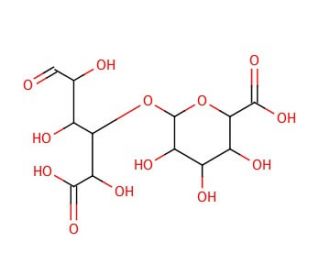

Digalacturonic acid の分子構造、CAS番号: 5894-59-7
Digalacturonic acid (CAS 5894-59-7)
参考文献をチェックします (2)
別名:
α-D-GalA-(1→4)-D-GalA
アプリケーション:
Digalacturonic acidは、プロテイナーゼKなどの酵素の共結晶化に使用されます
CAS 番号:
5894-59-7
純度:
≥85%
分子量:
370.26
分子式:
C12H18O13
試験・研究用以外には使用しないでください。 臨床及び体外診断には使用できません。
* Refer to Certificate of Analysis for lot specific data.
クイックリンク
注文情報
参考文献
説明
技術サポート情報
安全情報
SDSと分析証明書
ジガラクツロン酸は、2つのガラクツロン酸分子がグリコシド結合によって結合してできる多糖類で、多くの植物や藻類の細胞壁に天然に存在する。セルロースの構造に似ているジガラクツロン酸は、さまざまな用途でセルロースの代替品として使用されることが多い。科学的研究において,ジガラクツロン酸は広範な研究を経て,その多様な利点を明らかにした。ペクチナーゼやキシラナーゼなどの酵素の産生に利用されており、植物細胞壁の分解を助ける。さらに、ジガラクツロン酸はセルロースのような多糖類の合成に役立ち、生分解性物質の生成を可能にしている。さらに、TogMNABABCトランスポーターなどのシステムによるオリゴガラクツロニドの輸送を研究するために使用される。ジガラクツロン酸の正確な作用機序はまだ完全には解明されていないが、タンパク質、脂質、炭水化物と結合する能力に由来すると考えられている。ジガラクツロン酸の高度に分岐した構造は、他の分子との複数の水素結合による相互作用を促進する。
Digalacturonic acid (CAS 5894-59-7) 参考文献
- 植物におけるプロテイナーゼ阻害遺伝子のオリゴウロニドシグナル:ジ-およびトリガラクチュロン酸とその誘導体の構造活性相関。 | Moloshok, T., et al. 1992. Arch Biochem Biophys. 294: 731-4. PMID: 1567229
- ヒト腸内細菌Clostridium butyricum-beijerinckiiグループ由来の2種類のペクチン酸リアーゼによるペクチン性物質の分解。 | Nakajima, N., et al. 1999. J Biosci Bioeng. 88: 331-3. PMID: 16232622
- ペクチン異化に関与するペリプラズム結合タンパク質による飽和および4,5-不飽和ヘクスロン酸糖の特異的認識。 | Abbott, DW. and Boraston, AB. 2007. J Mol Biol. 369: 759-70. PMID: 17451747
- ジガラクチュロン酸と共結晶化したプロテイナーゼKの高分解能構造。 | Larson, SB., et al. 2009. Acta Crystallogr Sect F Struct Biol Cryst Commun. 65: 192-8. PMID: 19255463
- Selenomonas ruminantiumのペクチン分解酵素。 | Heinrichova, K., et al. 1989. J Appl Bacteriol. 66: 169-74. PMID: 2708171
- メタボロミクスによるCyathula officinalis Kuanの根における代謝の年次変化をガスクロマトグラフィー質量スペクトルから明らかにした。 | Tong, K., et al. 2017. Chin Med. 12: 12. PMID: 28469699
- Bacillus paralicheniformisから精製したアルカリ性エンドポリガラクツロナーゼの固定化により, 綿織物のバイオコーティングが可能になった。 | Khan, MM., et al. 2018. Bioprocess Biosyst Eng. 41: 1425-1436. PMID: 29926218
- 模擬無重力はラットの腸内メタボローム・プロファイルを変化させる。 | Jin, M., et al. 2019. Front Physiol. 10: 1279. PMID: 31680997
- Aspergillus nidulans由来ペクチン酸リアーゼAnPL9の生化学的性質。 | Suzuki, H., et al. 2022. Appl Biochem Biotechnol. 194: 5627-5643. PMID: 35802235
- アスペルギルス・ニガーのペクチン酵素。第二のエキソポリガラクツロナーゼ。 | Mill, PJ. 1966. Biochem J. 99: 562-5. PMID: 4960793
- アスペルギルス・ニガーのペクチン酵素。水銀活性化エキソポリガラクツロナーゼ。 | Mill, PJ. 1966. Biochem J. 99: 557-61. PMID: 5964957
- Erwinia chrysanthemiの細胞外ペクチン酸リアーゼ産生制御に関与するエキソ-ポリ-α-D-ガラクツロノシダーゼ。 | Collmer, A., et al. 1982. J Bacteriol. 149: 626-34. PMID: 7056698
- 溶液中におけるジガラクツロン酸とジガラクツロン酸ナトリウムの構造研究 | Gouvion, C., et al. 1994. Carbohydr Res. 261: 187-202. PMID: 7954511
- Erwinia chrysanthemi EC16におけるガラクツロン酸の取り込み。 | San Francisco, MJ. and Keenan, RW. 1993. J Bacteriol. 175: 4263-5. PMID: 8320243
注文情報
| 製品名 | カタログ # | 単位 | 価格 | 数量 | お気に入り | |
Digalacturonic acid, 10 mg | sc-214891 | 10 mg | $148.00 | |||
Digalacturonic acid, 25 mg | sc-214891A | 25 mg | $255.00 | |||
Digalacturonic acid, 100 mg | sc-214891B | 100 mg | $823.00 |