
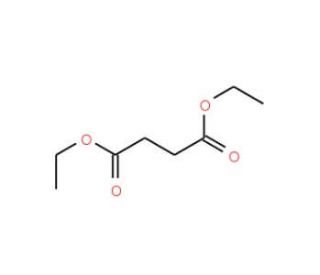

Diethyl succinate (CAS 123-25-1)
QUICK LINKS
Diethyl succinate is a chemical compound that functions as a reagent in organic synthesis. It acts as an esterification agent, facilitating the formation of ester bonds in various chemical reactions. In the presence of suitable catalysts, diethyl succinate can undergo transesterification reactions, allowing for the exchange of ester groups with other compounds. Diethyl Succinate can also participate in nucleophilic substitution reactions, where the ester group is replaced by a nucleophile. Diethyl succinate can serve as a starting material for the synthesis of various intermediates and fine chemicals. Its mechanism of action involves participating in chemical reactions by providing its ester group for bonding with other molecules, thereby enabling the formation of new compounds with specific properties.
Diethyl succinate (CAS 123-25-1) References
- Real-time molecular imaging of tricarboxylic acid cycle metabolism in vivo by hyperpolarized 1-(13)C diethyl succinate. | Zacharias, NM., et al. 2012. J Am Chem Soc. 134: 934-43. PMID: 22146049
- Chemoenzymatic resolution of rac-malathion. | Hitt, DM., et al. 2014. Tetrahedron Asymmetry. 25: 529-533. PMID: 24839353
- Towards Real-time Metabolic Profiling of Cancer with Hyperpolarized Succinate. | Zacharias, NM., et al. 2016. J Mol Imaging Dyn. 6: PMID: 27547490
- RIFM fragrance ingredient safety assessment diethyl succinate, CAS Registry Number 123-25-1. | Api, AM., et al. 2018. Food Chem Toxicol. 115 Suppl 1: S114-S123. PMID: 29288763
- Flow Photochemistry as a Tool for the Total Synthesis of (+)-Epigalcatin. | Lisiecki, K. and Czarnocki, Z. 2018. Org Lett. 20: 605-607. PMID: 29345466
- Anticonvulsant activity of deaminated analogues of glutamic acid diethyl ester (GDEE). | Freed, WJ. and Braun, DE. 1988. Brain Res. 459: 157-62. PMID: 3167573
- Aroma-active compounds, sensory profile, and phenolic composition of Fondillón. | Issa-Issa, H., et al. 2020. Food Chem. 316: 126353. PMID: 32044705
- Effect of rootstocks on volatile composition of Merlot wines. | Carrasco-Quiroz, M., et al. 2020. J Sci Food Agric. 100: 3517-3524. PMID: 32202325
- Volatile Profile Characterization of Croatian Commercial Sparkling Wines. | Jagatić Korenika, AM., et al. 2020. Molecules. 25: PMID: 32971979
- Mitochondrial Succinate Metabolism and Reactive Oxygen Species Are Important but Not Essential for Eliciting Carotid Body and Ventilatory Responses to Hypoxia in the Rat. | Swiderska, A., et al. 2021. Antioxidants (Basel). 10: PMID: 34070267
- Diethyl Succinate Modulates Microglial Polarization and Activation by Reducing Mitochondrial Fission and Cellular ROS. | Wang, L., et al. 2021. Metabolites. 11: PMID: 34940612
- Succinate Is a Natural Suppressor of Antiviral Immune Response by Targeting MAVS. | Xiao, Y., et al. 2022. Front Immunol. 13: 816378. PMID: 35309330
- Ischemic accumulation of succinate induces Cdc42 succinylation and inhibits neural stem cell proliferation after cerebral ischemia/reperfusion. | Huang, LY., et al. 2023. Neural Regen Res. 18: 1040-1045. PMID: 36254990
- [2,5-Bis(di-propyl-amino)-4-(hy-droxy-meth-yl)phen-yl]methanol. | Schmitt, V., et al. 2021. IUCrdata. 6: x210443. PMID: 36339103
Ordering Information
| Product Name | Catalog # | UNIT | Price | Qty | FAVORITES | |
Diethyl succinate, 25 g | sc-234671 | 25 g | $53.00 |