
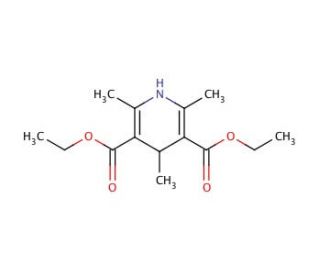

Diethyl 1,4-dihydro-2,4,6-trimethyl-3,5-pyridinedicarboxylate (CAS 632-93-9)
Veja citações de produtos (1)
LINKS RÁPIDOS
O 1,4-di-hidro-2,4,6-trimetil-3,5-piridinadecarboxilato de dietilo bloqueia a síntese do heme e impede a indução da heme oxigenase-1 hepática. Contribui para a formação de corpos de Mallory no fígado. O 1,4-dihidro-2,4,6-trimetil-3,5-piridinadecarboxilato de dietilo desempenha um papel no estudo de diversos aspectos, como a cinética enzimática, as vias metabólicas e a sinalização celular. Além disso, é útil para investigar a intrincada estrutura e função das proteínas e dos ácidos nucleicos. O 1,4-dihidro-2,4,6-trimetil-3,5-piridinadecarboxilato de dietilo visa eficazmente enzimas como as proteínas cinases e fosfatases, ligando-se aos seus locais activos, impedindo a ligação do substrato e dificultando a catálise enzimática. Além disso, o 1,4-dihidro-2,4,6-trimetil-3,5-piridinadecarboxilato de dietilo apresenta a capacidade de interagir com outras proteínas e ácidos nucleicos, potencialmente perturbando a sua estrutura e afectando a sua funcionalidade.
Diethyl 1,4-dihydro-2,4,6-trimethyl-3,5-pyridinedicarboxylate (CAS 632-93-9) Referencias
- A dexametasona aumenta a formação de corpos de mallory no fígado de ratinho preparado para a droga. | Yuan, QX., et al. 2000. Exp Mol Pathol. 69: 202-10. PMID: 11115361
- O papel da via ubiquitina-proteasoma na formação de corpos de mallory. | Bardag-Gorce, F., et al. 2002. Exp Mol Pathol. 73: 75-83. PMID: 12231209
- Indução do ARN do citocromo P-450 por agentes porfirogénicos: sobre a natureza da indução coordenada com a delta-aminolevulinato sintase em tecidos do embrião de galinha. | Drew, PD. and Ades, IZ. 1990. Int J Biochem. 22: 607-10. PMID: 1696217
- Perfil transcricional de células hepáticas embrionárias bipotenciais para identificar marcadores de superfície de células progenitoras do fígado. | Ochsner, SA., et al. 2007. Stem Cells. 25: 2476-87. PMID: 17641245
- A regulação da expressão de ARN não codificante no fígado de ratinhos alimentados com DDC. | Oliva, J., et al. 2009. Exp Mol Pathol. 87: 12-9. PMID: 19362547
- A SAMe previne a regulação positiva da sinalização dos receptores toll-like nos hepatócitos formadores de corpos de Mallory-Denk. | Bardag-Gorce, F., et al. 2010. Exp Mol Pathol. 88: 376-9. PMID: 20206621
- Sensibilidade e especificidade da ligação de proximidade in situ para análise da interação de proteínas num modelo de esteato-hepatite com corpos de Mallory-Denk. | Zatloukal, B., et al. 2014. PLoS One. 9: e96690. PMID: 24798445
- Regulação da produção de delta-aminolaevulinato sintase em tecidos de embriões de pinto. Efeitos dos agentes porfirogénicos e dos precursores do heme. | Drew, PD. and Ades, IZ. 1989. Biochem J. 262: 815-21. PMID: 2590168
- A Taurina Atenua a Inflamação Hepática em Ratos Alimentados com Álcool Crónico Através da Inibição da Sinalização TLR4/MyD88. | Lin, CJ., et al. 2015. J Med Food. 18: 1291-8. PMID: 26090712
- Purificação por afinidade de anticorpos específicos para os bloqueadores dos canais de Ca2+ da 1,4-dihidropiridina. | Sharp, AH. and Campbell, KP. 1987. Circ Res. 61: I37-45. PMID: 3308157
- Regulação do destino das células Lgr5 + por coordenação de receptores nucleares metabólicos durante a reparação do fígado. | Qin, D., et al. 2022. Theranostics. 12: 6130-6142. PMID: 36168631
- O ácido taurocólico promove a ativação das células estreladas hepáticas através da sinalização S1PR2/p38 MAPK/YAP em condições de colestase. | Yang, J., et al. 2023. Clin Mol Hepatol. 29: 465-481. PMID: 36800698
- O choque térmico in vivo induz a formação de corpos de Mallory no fígado de ratinho preparado para drogas. | Yuan, QX., et al. 1995. Exp Mol Pathol. 63: 63-76. PMID: 8759055
- Indução do corpo de Mallory no fígado de ratinho preparado para drogas. | Yuan, QX., et al. 1996. Hepatology. 24: 603-12. PMID: 8781332
- Formação de corpos de Mallory através da alimentação com etanol em ratos preparados para o consumo de drogas. | Zhang-Gouillon, ZQ., et al. 1998. Hepatology. 27: 116-22. PMID: 9425926
Informacoes sobre ordens
| Nome do Produto | Numero de Catalogo | UNID | Preco | Qde | FAVORITOS | |
Diethyl 1,4-dihydro-2,4,6-trimethyl-3,5-pyridinedicarboxylate, 25 g | sc-239721 | 25 g | $151.00 |