
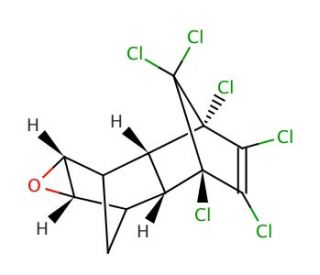

Dieldrin (CAS 60-57-1)
QUICK LINKS
Dieldrin is an organochlorine compound studied for its environmental impact and persistence as a pollutant. It was historically used as an insecticide, but due to its long-term environmental effects, Studies have shifted towards understanding its behavior in ecosystems and its bioaccumulation. Studies involve the monitoring of dieldrin residues in soil, water, and wildlife to assess contamination levels and the potential risks to ecosystems and non-target organisms. Analytical methods are developed and refined to detect and quantify trace amounts of dieldrin in environmental samples. Studies are conducted on the degradation of dieldrin by various physical, chemical, and biological processes to identify ways to remediate contaminated sites. The compound′s stability and resistance to degradation make it a subject of interest in the study of persistent organic pollutants (POPs) and their long-term ecological consequences.
Dieldrin (CAS 60-57-1) References
- Aldrin and dieldrin: a review of research on their production, environmental deposition and fate, bioaccumulation, toxicology, and epidemiology in the United States. | Jorgenson, JL. 2001. Environ Health Perspect. 109 Suppl 1: 113-39. PMID: 11250811
- Dieldrin elicits a widespread DNA repair and antioxidative response in mouse brain. | Sava, V., et al. 2007. J Biochem Mol Toxicol. 21: 125-35. PMID: 17623884
- Bioremediation of the organochlorine pesticides, dieldrin and endrin, and their occurrence in the environment. | Matsumoto, E., et al. 2009. Appl Microbiol Biotechnol. 84: 205-16. PMID: 19578846
- Dieldrin uptake and translocation in plants growing in hydroponic medium. | Murano, H., et al. 2010. Environ Toxicol Chem. 29: 142-8. PMID: 20821429
- Dieldrin-dissolving abilities of the xylem saps of several plant families, particularly Cucurbita pepo L. | Murano, H., et al. 2010. Environ Toxicol Chem. 29: 2269-77. PMID: 20872691
- Functional profiling discovers the dieldrin organochlorinated pesticide affects leucine availability in yeast. | Gaytán, BD., et al. 2013. Toxicol Sci. 132: 347-58. PMID: 23358190
- Biodegradation of Aldrin and Dieldrin by the White-Rot Fungus Pleurotus ostreatus. | Purnomo, AS., et al. 2017. Curr Microbiol. 74: 320-324. PMID: 28101603
- Toxicological profile of organochlorines aldrin and dieldrin: an Indian perspective. | Sharma, N., et al. 2017. Rev Environ Health. 32: 361-372. PMID: 28915126
- Status of Dieldrin in vegetable growing soils across a peri-urban agricultural area according to an adapted sampling strategy. | Colin, F., et al. 2022. Environ Pollut. 295: 118666. PMID: 34896399
- A global review of the temporal and spatial patterns of DDT and dieldrin monitoring in raptors. | Padayachee, K., et al. 2023. Sci Total Environ. 858: 159734. PMID: 36349626
- Dieldrin poisoning in dogs: relation to obesity and treatment. | Keane, WT., et al. 1969. Br J Ind Med. 26: 338-41. PMID: 5346832
- The relevance of fat content in toxicity of lipophilic chemicals to terrestrial animals with special reference to dieldrin and 2,3,7,8-tetrachlorodibenzo-p-dioxin (TCDD). | Geyer, HJ., et al. 1993. Ecotoxicol Environ Saf. 26: 45-60. PMID: 7691535
Ordering Information
| Product Name | Catalog # | UNIT | Price | Qty | FAVORITES | |
Dieldrin, 100 mg | sc-239716 | 100 mg | $191.00 |