
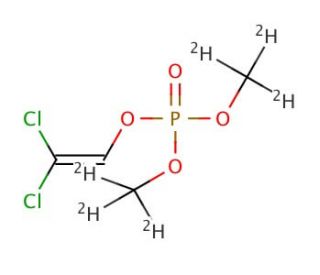

Dichlorvos-d6 (CAS 203645-53-8)
See product citations (1)
QUICK LINKS
Dichlorvos-d6, a deuterated analog of the organophosphate compound dichlorvos, is primarily utilized in research as an internal standard for mass spectrometry-based analytical methods. The incorporation of deuterium atoms allows for a clear distinction from the non-deuterated species, enabling precise quantification of dichlorvos in complex sample matrices. This is particularly valuable in environmental chemistry studies that monitor the presence and fate of organophosphate pesticides in agricultural settings. In addition to serving as a control in trace residue analysis, dichlorvos-d6 is used in mechanistic studies exploring the hydrolysis and biodegradation pathways of organophosphates, aiding in the understanding of their environmental impact. Moreover, it is a cholinesterase inhibitor.
Dichlorvos-d6 (CAS 203645-53-8) References
- Multiresidue analysis of pesticides in vegetables and fruits by gas chromatography/mass spectrometry after gel permeation chromatography and graphitized carbon column cleanup. | Ueno, E., et al. 2004. J AOAC Int. 87: 1003-15. PMID: 15295897
- Multiresidue method for trace pesticide analysis in honeybee wax comb by GC-QqQ-MS. | García, MD., et al. 2017. Talanta. 163: 54-64. PMID: 27886770
- Pesticide Residue Analysis in Fruit- and Vegetable-Based Baby Foods Using GC-Orbitrap MS. | Lozano, A., et al. 2018. J AOAC Int. 101: 374-382. PMID: 29141710
- A non-targeted metabolomic approach to identify food markers to support discrimination between organic and conventional tomato crops. | Martínez Bueno, MJ., et al. 2018. J Chromatogr A. 1546: 66-76. PMID: 29526497
- Identification and measurement of veterinary drug residues in beehive products. | Lozano, A., et al. 2019. Food Chem. 274: 61-70. PMID: 30372985
- Distribution of chemical residues in the beehive compartments and their transfer to the honeybee brood. | Murcia Morales, M., et al. 2020. Sci Total Environ. 710: 136288. PMID: 31927284
- Pesticide residues evaluation of organic crops. A critical appraisal. | Gómez-Ramos, MDM., et al. 2020. Food Chem X. 5: 100079. PMID: 32083251
- APIStrip, a new tool for environmental contaminant sampling through honeybee colonies. | Murcia-Morales, M., et al. 2020. Sci Total Environ. 729: 138948. PMID: 32380327
- Determination study of contaminants of emerging concern at trace levels in agricultural soil. A pilot study. | García Valverde, M., et al. 2021. Sci Total Environ. 782: 146759. PMID: 33838369
- Dissipation and cross-contamination of miticides in apiculture. Evaluation by APIStrip-based sampling. | Murcia-Morales, M., et al. 2021. Chemosphere. 280: 130783. PMID: 33964758
- Environmental monitoring study of pesticide contamination in Denmark through honey bee colonies using APIStrip-based sampling. | Murcia-Morales, M., et al. 2021. Environ Pollut. 290: 117888. PMID: 34450492
- Occurrence and human health risk assessment of mineral elements and pesticides residues in bee pollen. | Zafeiraki, E., et al. 2022. Food Chem Toxicol. 161: 112826. PMID: 35063474
- First national survey of residues of active substances in honeybee apiaries across Spain between 2012 and 2016. | Perez-Cobo, I., et al. 2022. Sci Total Environ. 838: 155614. PMID: 35504369
Ordering Information
| Product Name | Catalog # | UNIT | Price | Qty | FAVORITES | |
Dichlorvos-d6, 5 mg | sc-207558 | 5 mg | $281.00 |