
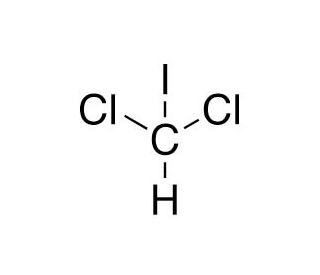

Dichloroiodomethane (CAS 594-04-7)
See product citations (1)
QUICK LINKS
Dichloroiodomethane (DCM), a clear and volatile liquid compound, possesses a colorless appearance. It is not flammable and only slightly toxic. This halogenated organic compound finds extensive application in scientific and industrial fields. Dichloroiodomethane is used as a solvent for organic compounds, a reagent in diverse reactions, and an ingredient in various mixtures. It serves as an intermediate during the manufacturing process of chemicals. Dichloroiodomethane plays a role in scientific disciplines such as organic synthesis, analytical chemistry, and biochemistry. Within organic synthesis, it acts as both a solvent and a reagent for different reactions. In analytical chemistry, Dichloroiodomethane is utilized as a solvent for chromatographic techniques like gas chromatography and high-performance liquid chromatography. In biochemistry, it serves as a reagent for enzyme-catalyzed reactions. While the precise mechanism of action of Dichloroiodomethane remains incompletely understood, it is believed to participate as a reactant in various reactions and can also function as a solvent for diverse compounds.
Dichloroiodomethane (CAS 594-04-7) References
- Determination of the odor threshold concentrations of iodinated trihalomethanes in drinking water. | Cancho, B., et al. 2001. J Agric Food Chem. 49: 1881-4. PMID: 11308340
- Quantification of dichloroiodomethane and bromochloroiodomethane in human blood by solid-phase microextraction coupled with gas chromatography-high-resolution mass spectrometry. | Silva, LK., et al. 2006. J Anal Toxicol. 30: 670-8. PMID: 17137527
- The impact of bromide/iodide concentration and ratio on iodinated trihalomethane formation and speciation. | Jones, DB., et al. 2012. Water Res. 46: 11-20. PMID: 22078225
- How the inclusion of treated water in beverages influences the appearance of halogenated volatile organic compounds. | Montesinos, I. and Gallego, M. 2014. J Agric Food Chem. 62: 10240-7. PMID: 25255208
- Seasonal evaluation of the presence of 46 disinfection by-products throughout a drinking water treatment plant. | Serrano, M., et al. 2015. Sci Total Environ. 517: 246-58. PMID: 25771439
- Occurrence and variability of iodinated trihalomethanes concentrations within two drinking-water distribution networks. | Ioannou, P., et al. 2016. Sci Total Environ. 543: 505-513. PMID: 26599150
- The influence of precursors and treatment process on the formation of Iodo-THMs in Canadian drinking water. | Tugulea, AM., et al. 2018. Water Res. 130: 215-223. PMID: 29223782
- Formation of DBPs and halogen-specific TOX in the presence of iopamidol and chlorinated oxidants. | Ackerson, NOB., et al. 2018. Chemosphere. 202: 349-357. PMID: 29574388
- Formation of iodinated trihalomethanes during breakpoint chlorination of iodide-containing water. | Liu, Z., et al. 2018. J Hazard Mater. 353: 505-513. PMID: 29709870
- Determination of six iodotrihalomethanes in drinking water in Korea. | Woo, B., et al. 2018. Sci Total Environ. 640-641: 581-590. PMID: 29870935
- Impact of chlorine exposure time on disinfection byproduct formation in the presence of iopamidol and natural organic matter during chloramination. | Ackerson, NOB., et al. 2019. J Environ Sci (China). 78: 204-214. PMID: 30665639
- Formation of emerging iodinated disinfection by-products during ballast water treatment based on ozonation processes. | Zhu, Y., et al. 2020. Sci Total Environ. 743: 140805. PMID: 32758847
- Formation of iodinated aromatic DBPs at different molar ratios of chlorine and nitrogen in iodide-containing water. | Song, H., et al. 2022. Sci Total Environ. 806: 150385. PMID: 34610565
- The fate and transformation of iodine species in UV irradiation and UV-based advanced oxidation processes. | Ye, T., et al. 2021. Water Res. 206: 117755. PMID: 34695669
- Selective adsorption mechanisms of iodinated trihalomethanes onto thiol-functionalized HKUST-1s in a mixed solute. | Induvesa, P., et al. 2022. J Environ Manage. 315: 115099. PMID: 35500481
Ordering Information
| Product Name | Catalog # | UNIT | Price | Qty | FAVORITES | |
Dichloroiodomethane, 50 mg | sc-499982 | 50 mg | $402.00 |