
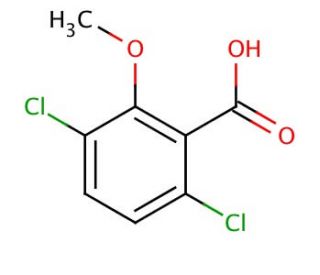

Dicamba (CAS 1918-00-9)
See product citations (3)
QUICK LINKS
Dicamba is a polar phenoxy herbicide employed for post-emergence control of broad-leaf weeds in grasslands and cereals. It possesses water emulsifiable properties. Its primary concern lies in its potential environmental impact, warranting immediate measures to restrict its spread. As a liquid, it has the capacity to permeate soil and contaminate groundwater and nearby streams. Inhalation, skin absorption, or ingestion of dicamba can lead to illness. Notably, dicamba functions as a herbicide. Chemically, dicamba is characterized as a methoxybenzoic acid, specifically O-methylsalicylic acid with chloro groups substituted at positions 3 and 6. It assumes multiple roles as a xenobiotic, environmental contaminant, herbicide, synthetic auxin, and agrochemical. Dicamba is classified as a methoxybenzoic acid and a dichlorobenzene. It acts as a conjugate acid of 3,6-dichloro-2-methoxybenzoate. In plants, dicamba operates as a chlorinated organic herbicide that imitates auxin plant growth hormones, leading to uncontrolled growth. However, this hormonal mode of action exclusively affects plants and does not impact animals. Studies indicate that dicamba can induce hepatic peroxisomal enzymes and activate the peroxisomal proliferator activator receptor (PPAR) in rats, suggesting potential liver tumor-promoting activity akin to other peroxisomal proliferators. However, investigations employing a two-stage hepatocarcinogenesis model in rats have not supported this hypothesis, revealing dicamba′s inactivity as a tumor promoter.
Dicamba (CAS 1918-00-9) References
- Remediating dicamba-contaminated water with zerovalent iron. | Gibb, C., et al. 2004. Chemosphere. 54: 841-8. PMID: 14637341
- Quantifying Dicamba Volatility under Field Conditions: Part I, Methodology. | Riter, LS., et al. 2020. J Agric Food Chem. 68: 2277-2285. PMID: 31990538
- Dicamba-Based Herbicides: Herbicidal Ionic Liquids versus Commercial Forms. | Pernak, J., et al. 2020. J Agric Food Chem. 68: 4588-4594. PMID: 32243143
- Dicamba use and cancer incidence in the agricultural health study: an updated analysis. | Lerro, CC., et al. 2020. Int J Epidemiol. 49: 1326-1337. PMID: 32357211
- Identification of environmental factors that influence the likelihood of off-target movement of dicamba. | Oseland, E., et al. 2020. Pest Manag Sci. 76: 3282-3291. PMID: 32385969
- Dicamba elevates concentrations of S-adenosyl methionine but does not induce oxidative stress or alter DNA methylation in rainbow trout (Oncorhynchus mykiss) hepatocytes. | Miller, JGP., et al. 2020. Comp Biochem Physiol Part D Genomics Proteomics. 36: 100744. PMID: 32950925
- Dicamba resistance in kochia from Kansas and Nebraska evolved independently. | Ou, J., et al. 2021. Pest Manag Sci. 77: 126-130. PMID: 32954607
- Conversations about the Future of Dicamba: The Science Behind Off-Target Movement. | Riter, LS., et al. 2021. J Agric Food Chem. 69: 14435-14444. PMID: 34817161
- Spray drift potential of dicamba plus S-metolachlor formulations. | Canella Vieira, B., et al. 2022. Pest Manag Sci. 78: 1538-1546. PMID: 34964546
- Utility of roller wiper applications of dicamba for Palmer amaranth control in soybean. | Farr, R., et al. 2022. Pest Manag Sci. 78: 2151-2160. PMID: 35170207
- Evaluation of dicamba volatilization when mixed with glyphosate using imazethapyr as a tracer. | Zaccaro-Gruener, ML., et al. 2022. J Environ Manage. 317: 115303. PMID: 35613534
- Inheritance of dicamba-resistance in allotetraploid Chenopodium album. | Ghanizadeh, H., et al. 2022. Pest Manag Sci. 78: 4939-4946. PMID: 36181421
- Environmental fate and effects of dicamba: a Canadian perspective. | Caux, PY., et al. 1993. Rev Environ Contam Toxicol. 133: 1-58. PMID: 8234942
Ordering Information
| Product Name | Catalog # | UNIT | Price | Qty | FAVORITES | |
Dicamba, 250 mg | sc-239692 | 250 mg | $29.00 | |||
Dicamba, 1 g | sc-239692A | 1 g | $71.00 | |||
Dicamba, 5 g | sc-239692B | 5 g | $242.00 |