
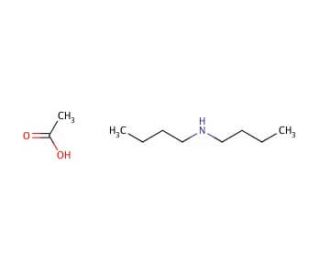

Molecular structure of Dibutylamine acetate Concentrate, CAS Number: 19070-91-8
Dibutylamine acetate Concentrate (CAS 19070-91-8)
Alternate Names:
N-butylbutan-1-amine
Application:
Dibutylamine acetate Concentrate is for ion pair chromatography
CAS Number:
19070-91-8
Molecular Weight:
189.30
Molecular Formula:
C8H19N•C2H4O2
For Research Use Only. Not Intended for Diagnostic or Therapeutic Use.
* Refer to Certificate of Analysis for lot specific data.
QUICK LINKS
Ordering Information
Description
Technical Information
Safety Information
SDS & Certificate of Analysis
Dibutylamine acetate Concentrate functions as a chemical intermediate in various industrial processes. It interacts with cellular and molecular components by influencing the synthesis of specific compounds and the regulation of certain biochemical pathways. Dibutylamine acetate Concentrate′s mechanism of action involves its ability to modulate the activity of enzymes involved in key cellular processes, such as metabolism and signal transduction. Dibutylamine acetate Concentrate affects the expression of genes related to cell growth and differentiation. It interacts with membrane receptors, leading to the modulation of intracellular signaling cascades.
Dibutylamine acetate Concentrate (CAS 19070-91-8) References
- Thermodynamics of Amide + Amine Mixtures. 1. Volumetric, Speed of Sound, and Refractive Index Data for N,N-Dimethylformamide + N-Propylpropan-1-amine, + N-Butylbutan-1-amine, + Butan-1-amine, or + Hexan-1-amine Systems at Several Temperatures | Fernando Hevia, Ana Cobos, Juan Antonio González*, Isaías García de la Fuente, and Luis Felipe Sanz. 2016. Journal of Chemical & Engineering Data. 61: 1468–1478.
- Thermodynamics of Amide + Amine Mixtures. 2. Volumetric, Speed of Sound and Refractive Index Data for N,N-Dimethylacetamide + N-Propylpropan-1-Amine, + N-Butylbutan-1-Amine, + Butan-1-Amine, or + Hexan-1-Amine Systems at Several Temperatures | Fernando Hevia, Ana Cobos, Juan Antonio González, Isaías García de la Fuente & Víctor Alonso. 2017. Journal of Solution Chemistry. 46: 150–174.
- Thermodynamics of amide + amine mixtures. 3. Relative permittivities of N,N-dimethylformamide + N-propylpropan-1-amine, + N-butylbutan-1-amine, + butan-1-amine, or + hexan-1-amine systems at several temperatures | Fernando Hevia, Juan Antonio González, Isaías García de la Fuente, Luis Felipe Sanz, José Carlos Cobos. 2017. Journal of Molecular Liquids. 238: 440-446.
- Thermodynamics of amide + amine mixtures. 4. Relative permittivities of N,N-dimethylacetamide + N-propylpropan-1-amine, + N-butylbutan-1-amine, + butan-1-amine, or + hexan-1-amine systems and of N,N-dimethylformamide + aniline mixture at several temperatures. Characterization of amine + amide systems using ERAS | Fernando Hevia, Juan Antonio González, Ana Cobos, Isaías García de la Fuente, Luis Felipe Sanz. 2018. The Journal of Chemical Thermodynamics. 118: 175-187.
- Thermodynamics of amide + amine mixtures. 5. Excess molar enthalpies of N,N-dimethylformamide or N,N-dimethylacetamide + N-propylpropan-1-amine, + N-butylbutan-1-amine, + butan-1-amine, or + hexan-1-amine systems at 298.15 K. Application of the ERAS model | Fernando Hevia a, Karine Ballerat-Busserolles b, Yohann Coulier b, Jean-Yves Coxam b, Juan Antonio González a, Isaías García de la Fuente a, José Carlos Cobos a. 2019. Fluid Phase Equilibria. 502: 112283.
- Aza-Michael Mono- and Bis-Addition of Primary and Secondary Amines Promoted by Silica-Supported Polyphosphoric Acid, PPA/SiO2 | Prof. Giovanna Bosica, Ryan Saliba. 2022. ChemistrySelect,. 7.
Ordering Information
| Product Name | Catalog # | UNIT | Price | Qty | FAVORITES | |
Dibutylamine acetate Concentrate, 10 ml | sc-257326 | 10 ml | $57.00 | |||
Dibutylamine acetate Concentrate, 100 ml | sc-257326A | 100 ml | $305.00 |