
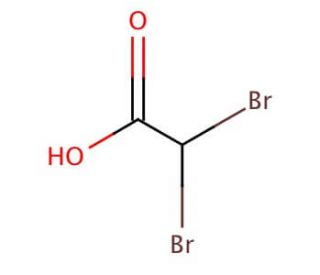

Dibromoacetic acid (CAS 631-64-1)
QUICK LINKS
Dibromoacetic acid (DBA) is a significant organic compound widely employed in various scientific domains over the years. It serves as a dibrominated carboxylic acid extensively used in synthetic organic chemistry for its role as a reagent in organic synthesis and as an intermediate in dye. Dibromoacetic acid has proven instrumental in multiple scientific research applications. Additionally, Dibromoacetic acid aids in studying the biochemical impacts of various compounds by interacting with enzymes and receptors, thereby influencing the metabolism and excretion of said compounds. Lastly, Dibromoacetic acid assists in exploring the advantages and limitations of laboratory experiments by acting as a valuable reagent in organic synthesis and an intermediary in the production of dyes. Although the precise mechanism of action of Dibromoacetic acid remains elusive, it is believed to interact with specific enzymes and receptors. Notably, Dibromoacetic acid interacts with enzymes such as cytochrome P450. Furthermore, Dibromoacetic acid interacts with receptors such as G-protein coupled receptors.
Dibromoacetic acid (CAS 631-64-1) References
- Dibromoacetic acid, a prevalent by-product of drinking water disinfection, compromises the synthesis of specific seminiferous tubule proteins following both in vivo and in vitro exposures. | Holmes, M., et al. 2001. J Androl. 22: 878-90. PMID: 11545302
- Dibromoacetic acid-induced elevations in circulating estradiol: effects in both cycling and ovariectomized/steroid-primed female rats. | Goldman, JM. and Murr, AS. 2003. Reprod Toxicol. 17: 585-92. PMID: 14555197
- Neurotoxicity produced by dibromoacetic acid in drinking water of rats. | Moser, VC., et al. 2004. Toxicol Sci. 79: 112-22. PMID: 14976349
- Toxicology and carcinogenesis studies of dibromoacetic acid (Cas No. 631-64-1) in F344/N rats and B6C3F1 mice (drinking water studies). | ,. 2007. Natl Toxicol Program Tech Rep Ser. 1-320. PMID: 17554398
- Physiologically based pharmacokinetic modeling of dibromoacetic acid in F344 rats. | Matthews, JL., et al. 2010. Toxicol Appl Pharmacol. 244: 196-207. PMID: 20045428
- Immunotoxicity of dibromoacetic acid administered via drinking water to female B₆C₃F₁ mice. | Smith, MJ., et al. 2010. J Immunotoxicol. 7: 333-43. PMID: 20958156
- Role of cytochrome P450c17α in dibromoacetic acid-induced testicular toxicity in rats. | Carr, TL., et al. 2011. Arch Toxicol. 85: 513-23. PMID: 21046364
- Low concentrations of dibromoacetic acid and N-nitrosodimethylamine induce several stimulatory effects in the invertebrate model Caenorhabditis elegans. | Baberschke, N., et al. 2015. Chemosphere. 124: 122-8. PMID: 25556763
- Dibromoacetic Acid Induces Thymocyte Apoptosis by Blocking Cell Cycle Progression, Increasing Intracellular Calcium, and the Fas/FasL Pathway in Vitro. | Gao, SY., et al. 2016. Toxicol Pathol. 44: 88-97. PMID: 26704929
- The toxic influence of dibromoacetic acid on the hippocampus and pre-frontal cortex of rat: involvement of neuroinflammation response and oxidative stress. | Jiang, W., et al. 2017. Metab Brain Dis. 32: 2009-2019. PMID: 28844098
- Dibromoacetic acid induced Cl.Ly1+2/-9 T-cell apoptosis and activation of MAPKs signaling cascades. | Zhou, XR., et al. 2018. Toxicol In Vitro. 47: 156-164. PMID: 29155130
- Dibromoacetic Acid Induced Hepatotoxicity in Mice through Oxidative Stress and Toll-Like Receptor 4 Signaling Pathway Activation. | Gong, T., et al. 2019. Oxid Med Cell Longev. 2019: 5637235. PMID: 31827682
- Dibromoacetic acid exposure is associated with abnormal melatonin rhythm in rats via inhibition of p-CREB1-AANAT signalling pathway. | Jiang, W., et al. 2021. Ecotoxicol Environ Saf. 208: 111401. PMID: 33038730
- Dibromoacetic acid affects reproductive competence and sperm quality in the male rat. | Linder, RE., et al. 1995. Fundam Appl Toxicol. 28: 9-17. PMID: 8566488
- Dibromoacetic acid does not adversely affect early pregnancy in rats. | Cummings, AM. and Hedge, JM. 1998. Reprod Toxicol. 12: 445-8. PMID: 9717694
Ordering Information
| Product Name | Catalog # | UNIT | Price | Qty | FAVORITES | |
Dibromoacetic acid, 25 g | sc-257320 | 25 g | $245.00 |