
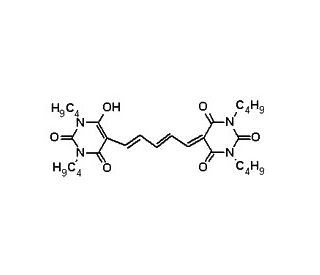

Molecular structure of DiBAC4(5), CAS Number: 63560-89-4
DiBAC4(5) (CAS 63560-89-4)
Alternate Names:
Bis-(1,3-dibutylbarbituric acid)pentamethine oxonol
CAS Number:
63560-89-4
Molecular Weight:
542.67
Molecular Formula:
C29H42N4O6
For Research Use Only. Not Intended for Diagnostic or Therapeutic Use.
* Refer to Certificate of Analysis for lot specific data.
QUICK LINKS
Ordering Information
Description
Technical Information
Safety Information
SDS & Certificate of Analysis
DiBAC4(5) is a derivative of barbituric acid, which is a heterocyclic compound used to synthesize barbiturates and other drugs. DiBAC4(5) is useful as a fluorescent probe in a variety of applications, such as imaging, sensing, and drug delivery. Upon binding to biological targets, including proteins, DNA, and lipids, this compound emits fluorescence, which can be detected and used to study the interactions between the target molecules.
DiBAC4(5) (CAS 63560-89-4) References
- In situ measurement of the electrical potential across the phagosomal membrane using FRET and its contribution to the proton-motive force. | Steinberg, BE., et al. 2007. Proc Natl Acad Sci U S A. 104: 9523-8. PMID: 17517624
- Voltage-dependent dynamic FRET signals from the transverse tubules in mammalian skeletal muscle fibers. | DiFranco, M., et al. 2007. J Gen Physiol. 130: 581-600. PMID: 18040060
- Transporter-mediated GABA responses in horizontal and bipolar cells of zebrafish retina. | Nelson, R., et al. 2008. Vis Neurosci. 25: 155-65. PMID: 18442438
- Functional role of coenzyme Q in the energy coupling of NADH-CoQ oxidoreductase (Complex I): stabilization of the semiquinone state with the application of inside-positive membrane potential to proteoliposomes. | Ohnishi, T., et al. 2008. Biofactors. 32: 13-22. PMID: 19096096
- Changes in astrocyte shape induced by sublytic concentrations of the cholesterol-dependent cytolysin pneumolysin still require pore-forming capacity. | Förtsch, C., et al. 2011. Toxins (Basel). 3: 43-62. PMID: 22069689
- Visualization of pinholin lesions in vivo. | Pang, T., et al. 2013. Proc Natl Acad Sci U S A. 110: E2054-63. PMID: 23671069
- Bacterial cytological profiling rapidly identifies the cellular pathways targeted by antibacterial molecules. | Nonejuie, P., et al. 2013. Proc Natl Acad Sci U S A. 110: 16169-74. PMID: 24046367
- Intracellular trehalose and sorbitol synergistically promoting cell viability of a biocontrol yeast, Pichia anomala, for aflatoxin reduction. | Hua, SS., et al. 2015. World J Microbiol Biotechnol. 31: 729-34. PMID: 25700743
- Cell-autonomous regulation of Mu-opioid receptor recycling by substance P. | Bowman, SL., et al. 2015. Cell Rep. 10: 1925-36. PMID: 25801029
- Hb40-61a: Novel analogues help expanding the knowledge on chemistry, properties and candidacidal action of this bovine α-hemoglobin-derived peptide. | Carvalho, LA., et al. 2015. Biochim Biophys Acta. 1848: 3140-9. PMID: 26367061
- Cholesterol-directed nanoparticle assemblies based on single amino acid peptide mutations activate cellular uptake and decrease tumor volume. | Li, S., et al. 2017. Chem Sci. 8: 7552-7559. PMID: 29163910
- A Membrane Potential- and Calpain-Dependent Reversal of Caspase-1 Inhibition Regulates Canonical NLRP3 Inflammasome. | Zhang, Y., et al. 2018. Cell Rep. 24: 2356-2369.e5. PMID: 30157429
- Epithelial tissue geometry directs emergence of bioelectric field and pattern of proliferation. | Silver, BB., et al. 2020. Mol Biol Cell. 31: 1691-1702. PMID: 32520653
Ordering Information
| Product Name | Catalog # | UNIT | Price | Qty | FAVORITES | |
DiBAC4(5), 25 mg | sc-499460 | 25 mg | $193.00 |