
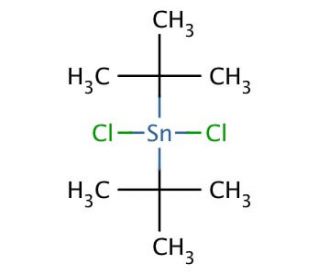

Di-tert-butyltin dichloride (CAS 19429-30-2)
QUICK LINKS
Di-tert-butyltin dichloride is a compound of interest in organotin chemistry, an area of research that examines the synthesis and reactivity of tin-containing organic compounds. It is used as a starting material for the preparation of other organotin compounds through stannylations or as a catalyst in organic reactions. Research on di-tert-butyltin dichloride focuses on its potential as a catalyst for esterification and transesterification processes, which are fundamental reactions in the production of various organic compounds. The compound′s behavior in polymer chemistry is also an area of study, particularly in the catalysis of polymerization reactions. Investigations into the recyclability and reusability of di-tert-butyltin dichloride in catalytic systems are of interest to enhance the efficiency and sustainability of industrial chemical processes. Additionally, the study of its interaction with different ligands contributes to the field of inorganic chemistry by providing insights into the coordination chemistry of tin.
Di-tert-butyltin dichloride (CAS 19429-30-2) References
- Molecular Dynamics within Diorganotin Systems: Solution and Solid State Studies of New Mixed Distannoxane Dimers [(t)Bu(2)(Cl)SnOSn(Cl)R(2)](2). | Dakternieks, D., et al. 1997. Inorg Chem. 36: 2023-2029. PMID: 11669818
- A paramagnetic heterobimetallic polymer: synthesis, reactivity, and ring-opening polymerization of tin-bridged homo- and heteroleptic vanadoarenophanes. | Braunschweig, H., et al. 2015. J Am Chem Soc. 137: 1492-500. PMID: 25565127
- Organotin compounds II. π-bonding and the electric dipole moments of some organotin chlorides | Huang, H. H., Hui, K. M., & Chiu, K. K. 1968. Journal of Organometallic Chemistry. 11: 515-524.
- (Bis {2, 4, 6-triisopropylphenyl} stannylene) ferrocenophane and related ring-opened products | Sharma, H. K., Cervantes-Lee, F., Mahmoud, J. S., & Pannell, K. H. 1999. Organometallics. 18(3): 399-403.
- Stannasiloxanes: from rings to polymers | Beckmann, J., & Jurkschat, K. 2001. Coordination Chemistry Reviews. 215(1): 267-300.
- Comparison of the flexibility of eight-membered tetrasiloxane and stannasiloxane rings: a crystallographic and computational study | Beckmann, J., Jurkschat, K., Schürmann, M., Dakternieks, D., Lim, A. E., & Lim, K. F. 2001. Organometallics. 20(24): 5125-5133.
- 1 J WSn as a Solution State Predictor for Tungsten− Tin Solid State Bond Length in Sterically Crowded Tungstenocene Stannyl Complexes | Mobley, T. A., Gandour, R., Gillis, E. P., Nti-Addae, K., Palchaudhuri, R., Rajbhandari, P.,.. & Zheng, Q. 2005. Organometallics. 24(16): 3897-3906.
- Steric control in the reactions of 3-pyrazolecarboxylic acid with diorganotin dichlorides | Chandrasekhar, V., Thirumoorthi, R., Metre, R. K., & Mahanti, B. 2011. Journal of Organometallic Chemistry. 696(2): 600-606.
- Synthesis, Reactivity and Ring‐Opening Polymerization of a Tin‐Bridged ansa‐Cycloheptatrienyl‐Cyclopentadienyl Titanium Sandwich Complex | Tagne Kuate, A. C., Daniliuc, C. G., Jones, P. G., & Tamm, M. 2012. European Journal of Inorganic Chemistry. 2012(11): 1727-1733.
- The influence of the sample introduction system on signals of different tin compounds in inductively coupled plasma-based techniques | Montiel, J., Grindlay, G., Gras, L., de Loos-Vollebregt, M. T., & Mora, J. 2013. Spectrochimica Acta Part B: Atomic Spectroscopy. 81: 36-42.
- Tuning the supramolecular structure through variation of the ligand geometry and metal substituents–diorganotin macrocycles and coordination polymers derived from cis-and trans-1, 2-, 1, 3-, and 1, 4-cyclohexanedicarboxylic and cis, cis-1, 3, 5-cyclohexanetricarboxylic acid | Hernández-Ahuactzi, I. F., Cruz-Huerta, J., Tlahuext, H., Barba, V., Guerrero-Alvarez, J., & Höpfl, H. 2015. Crystal Growth & Design. 15(2): 829-847.
- Redox-induced C–C bond formation reaction between mono-o-amidophenolate tin complexes and allylhalides | Piskunov, A. V., Chegerev, M. G., & Fukin, G. K. 2016. Journal of Organometallic Chemistry. 803: 51-57.
- New sterically hindered tin (IV) siloxane precursors to tinsilicate materials: synthesis, spectral, structural and photocatalytic studies | Gopalakrishnan, M., & Palanisami, N. 2016. RSC advances. 6(3): 1760-1768.
Ordering Information
| Product Name | Catalog # | UNIT | Price | Qty | FAVORITES | |
Di-tert-butyltin dichloride, 1 g | sc-234539 | 1 g | $72.00 |