
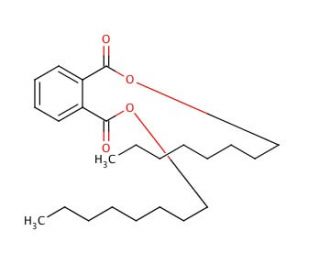

Molecular structure of Di-n-octyl phthalate, CAS Number: 117-84-0
Di-n-octyl phthalate (CAS 117-84-0)
Alternate Names:
DNOP; Phthalic acid di-n-octyl ester
CAS Number:
117-84-0
Molecular Weight:
390.56
Molecular Formula:
C24H38O4
For Research Use Only. Not Intended for Diagnostic or Therapeutic Use.
* Refer to Certificate of Analysis for lot specific data.
QUICK LINKS
Ordering Information
Description
Technical Information
Safety Information
SDS & Certificate of Analysis
Di-n-octyl phthalate, categorized as a plasticizer, is found widely in the environment. It is used in the production of flooring tiles, bottle cap liners, toys, and even indirect food addititives. Di-n-octyl phthalate is a phthalate as a plasticizer in polyvinyl chloride and used as an analytical reagent for determining activated phthalates in water, food, and human serum samples. Studies show that di-n-octyl phthalate can inhibit mitochondrial function and cellular respiration. Additionally, it has shown to blocking protein synthesis, resulting in the inhibition of bacterial growth, as seen with Escherichia coli.
Di-n-octyl phthalate (CAS 117-84-0) References
- NTP Center for the Evaluation of Risks to Human Reproduction: phthalates expert panel report on the reproductive and developmental toxicity of di-n-octyl phthalate. | Kavlock, R., et al. 2002. Reprod Toxicol. 16: 721-34. PMID: 12406498
- Urinary metabolites of di-n-octyl phthalate in rats. | Silva, MJ., et al. 2005. Toxicology. 210: 123-33. PMID: 15840426
- Mono-(3-carboxypropyl) phthalate, a metabolite of di-n-octyl phthalate. | Calafat, AM., et al. 2006. J Toxicol Environ Health A. 69: 215-27. PMID: 16263692
- Prenatal developmental toxicity studies on di-n-heptyl and di-n-octyl phthalates in Sprague-Dawley rats. | Saillenfait, AM., et al. 2011. Reprod Toxicol. 32: 268-76. PMID: 21907788
- Complete degradation of di-n-octyl phthalate by Gordonia sp. strain Dop5. | Sarkar, J., et al. 2013. Chemosphere. 90: 2571-7. PMID: 23211327
- Biochemical pathways and enhanced degradation of di-n-octyl phthalate (DOP) in sequencing batch reactor (SBR) by Arthrobacter sp. SLG-4 and Rhodococcus sp. SLG-6 isolated from activated sludge. | Zhang, K., et al. 2018. Biodegradation. 29: 171-185. PMID: 29450665
- Di-n-octyl phthalate degradation by a halotolerant bacterial consortium LF and its application in soil. | Wang, Y., et al. 2021. Environ Technol. 42: 2749-2756. PMID: 31961776
- Exposure to di-n-octyl phthalate during puberty induces hypergonadotropic hypogonadism caused by Leydig cell hyperplasia but reduced steroidogenic function in male rats. | Zhu, X., et al. 2021. Ecotoxicol Environ Saf. 208: 111432. PMID: 33075588
- Biodegradation of di-n-octyl phthalate by Gordonia sp. Lff and its application in soil. | Wang, Y., et al. 2022. Environ Technol. 43: 2604-2611. PMID: 33577396
- Development of ecological risk assessment for Diisobutyl phthalate and di-n-octyl phthalate in surface water of China based on species sensitivity distribution model. | Huan-Yu, T., et al. 2022. Chemosphere. 307: 135932. PMID: 35940414
- Effect of di-n-octyl phthalate on fatty acid composition of phosphatidylcholine in Tetrahymena. | Kaya, K. and Nohara, K. 1987. Chem Biol Interact. 64: 93-101. PMID: 3690725
- Comparison of the short-term effects of di(2-ethylhexyl) phthalate, di(n-hexyl) phthalate, and di(n-octyl) phthalate in rats. | Mann, AH., et al. 1985. Toxicol Appl Pharmacol. 77: 116-32. PMID: 3966235
- Comparative studies of the hepatic effects of di- and mono-n-octyl phthalates, di-(2-ethylhexyl) phthalate and clofibrate in the rat. | Lake, BG., et al. 1984. Acta Pharmacol Toxicol (Copenh). 54: 167-76. PMID: 6720315
- Subchronic oral toxicity of di-n-octyl phthalate and di(2-Ethylhexyl) phthalate in the rat. | Poon, R., et al. 1997. Food Chem Toxicol. 35: 225-39. PMID: 9146736
Ordering Information
| Product Name | Catalog # | UNIT | Price | Qty | FAVORITES | |
Di-n-octyl phthalate, 1 g | sc-257308 | 1 g | $59.00 | |||
Di-n-octyl phthalate, 10 g | sc-257308A | 10 g | $255.00 | |||
Di-n-octyl phthalate, 50 g | sc-257308B | 50 g | $561.00 |