
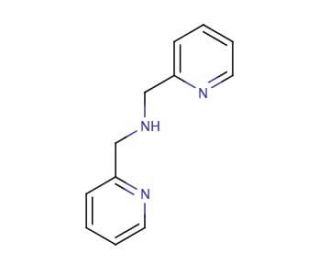

Di-(2-picolyl)amine (CAS 1539-42-0)
QUICK LINKS
Di-(2-picolyl)amine is a compound that functions as a bidentate ligand in coordination chemistry. It has the ability to form stable complexes with various metal ions, such as copper, nickel, and zinc, through the donation of lone pairs of electrons from the nitrogen atoms in its pyridine rings. Di-(2-Picolyl)Amine′s mechanism of action involves chelating metal ions, leading to the formation of coordination complexes with specific geometries and stabilities. These complexes can be utilized in various experimental applications, including catalysis, material synthesis, and coordination chemistry studies. The compound′s ability to coordinate with metal ions allows for the manipulation of their reactivity and selectivity in chemical reactions, making it useful in the development of new synthetic methodologies and functional materials. The compound′s coordination properties can be exploited in the design and synthesis of novel metal-based catalysts for organic transformations and industrial processes.
Di-(2-picolyl)amine (CAS 1539-42-0) References
- Dynamic multicomponent hemiaminal assembly. | You, L., et al. 2011. Chemistry. 17: 11017-23. PMID: 21919095
- Guanine nucleobase adducts formed by [Pt(di-(2-picolyl)amine)Cl]Cl: evidence that a tridentate ligand with only in-plane bulk can slow guanine base rotation. | Andrepont, C., et al. 2012. Inorg Chem. 51: 11961-70. PMID: 23094695
- Metal complexes with functionalised 2,2'-dipicolylamine ligand containing an antioxidant 2,6-di-tert-butylphenol moiety: synthesis and biological studies. | Milaeva, ER., et al. 2013. Dalton Trans. 42: 6817-28. PMID: 23493924
- Label-Free Pyrophosphate Recognition with Functionalized Asymmetric Nanopores. | Ali, M., et al. 2016. Small. 12: 2014-21. PMID: 26939057
- Ditopic binuclear copper(II) complexes for DNA cleavage. | Carreira-Barral, I., et al. 2020. J Inorg Biochem. 205: 110995. PMID: 31955057
- Europium(III) Macrocyclic Chelates Appended with Tyrosine-based Chromophores and Di-(2-picolyl)amine-based Receptors: Turn-On Luminescent Chemosensors Selective to Zinc(II) Ions. | Wang, G., et al. 2020. Chempluschem. 85: 806-814. PMID: 31967740
- Europium(III) Macrocyclic Chelates Appended with Tyrosine-based Chromophores and Di-(2-picolyl)amine-based Receptors: Turn-On Luminescent Chemosensors Selective to Zinc(II) Ions. | Wang, G., et al. 2020. Chempluschem. 85: 796. PMID: 32293103
- Molecular Insights Into Di(2-Picolyl) Amine-Induced Cytotoxicity and Apoptosis in Human Kidney (HEK293) Cells. | Satyo, L., et al. 2020. Int J Toxicol. 39: 341-351. PMID: 32351145
- Ligand design for human acetylcholinesterase and nicotinic acetylcholine receptors, extending beyond the conventional and canonical. | Taylor, P., et al. 2021. J Neurochem. 158: 1217-1222. PMID: 33638151
- Di-(2-picolyl)amine functionalized tetraphenylethylene as multifunctional chemosensor. | Kang, Z., et al. 2022. Anal Chim Acta. 1196: 339543. PMID: 35151401
- Enzymatic Synthesis of Chemical Nuclease Triplex-Forming Oligonucleotides with Gene-Silencing Applications. | McGorman, B., et al. 2022. Nucleic Acids Res. 50: 5467-5481. PMID: 35640595
- A sensitive zinc probe operating via enhancement of excited-state intramolecular charge transfer. | Kumar, GD., et al. 2022. Org Biomol Chem. 20: 7439-7447. PMID: 36102673
- A Near InfraRed Emissive Chemosensor for Zn2+ and Phosphate Derivatives Based on a Di-(2-picolyl)amine-styrylflavylium Push-Pull Fluorophore. | Gomes, LJ., et al. 2023. Sensors (Basel). 23: PMID: 36617069
- A Novel D-π-A Type Fluorescent Probe for Cu2+ Based on Styryl-Pyridinium Salts Conjugating Di-(2-picolyl)amine (DPA) Units. | Cao, R., et al. 2023. J Fluoresc.. PMID: 36787040
Ordering Information
| Product Name | Catalog # | UNIT | Price | Qty | FAVORITES | |
Di-(2-picolyl)amine, 1 g | sc-255072 | 1 g | $36.00 |