
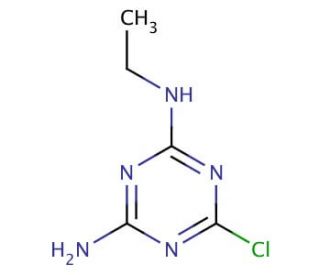

Desisopropyl Atrazine (CAS 1007-28-9)
QUICK LINKS
Deisopropyl atrazine is a synthetic compound that is a degradation product of atrazine, a used herbicide in agricultural contexts. Atrazine is known for its effectiveness in controlling broadleaf and grassy weeds, but it has also raised environmental concerns due to its persistence and potential to contaminate water supplies through runoff and leaching. The degradation process of atrazine into desisopropyl atrazine can occur in soil and water environments, mediated by microbial action or chemical reactions. Understanding the degradation pathways of atrazine, including the formation of products like deisopropyl atrazine, is for assessing the environmental impact of this herbicide and implementing strategies to mitigate its persistence in ecosystems. Deisopropyl atrazine′s is used to study the effects of environmental pollutants on aquatic organisms, as well as examining the influence of pesticides on plant growth and development. It is believed to act as an agonist of the GABAA receptor, leading to a reduction in neuronal excitability.
Desisopropyl Atrazine (CAS 1007-28-9) References
- Determination of atrazine and its metabolites in mouse urine and plasma by LC-MS analysis. | Ross, MK. and Filipov, NM. 2006. Anal Biochem. 351: 161-73. PMID: 16527233
- Quantification of atrazine, phenylurea, and sulfonylurea herbicide metabolites in urine by high-performance liquid chromatography-tandem mass spectrometry. | Nguyen, JV., et al. 2007. J Anal Toxicol. 31: 181-6. PMID: 17555640
- Molecularly imprinted polymer applied to the determination of the residual mass of atrazine and metabolites within an agricultural catchment (Brévilles, France). | Amalric, L., et al. 2008. J Chromatogr A. 1206: 95-104. PMID: 18760796
- A physiologically based pharmacokinetic model for atrazine and its main metabolites in the adult male C57BL/6 mouse. | Lin, Z., et al. 2011. Toxicol Appl Pharmacol. 251: 16-31. PMID: 21094656
- Urinary biomarkers of prenatal atrazine exposure and adverse birth outcomes in the PELAGIE birth cohort. | Chevrier, C., et al. 2011. Environ Health Perspect. 119: 1034-41. PMID: 21367690
- Atrazine contamination at the watershed scale and environmental factors affecting sampling rates of the polar organic chemical integrative sampler (POCIS). | Dalton, RL., et al. 2014. Environ Pollut. 189: 134-42. PMID: 24661999
- Degradation and transformation of atrazine under catalyzed ozonation process with TiO2 as catalyst. | Yang, Y., et al. 2014. J Hazard Mater. 279: 444-51. PMID: 25106044
- Degradation of atrazine by UV/chlorine: Efficiency, influencing factors, and products. | Kong, X., et al. 2016. Water Res. 90: 15-23. PMID: 26724435
- On-line solid-phase extraction method for determination of triazine herbicides and degradation products in seawater by ultra-pressure liquid chromatography-tandem mass spectrometry. | Rodríguez-González, N., et al. 2016. J Chromatogr A. 1470: 33-41. PMID: 27726863
- In utero exposure to atrazine analytes and early menarche in the Avon Longitudinal Study of Parents and Children Cohort. | Namulanda, G., et al. 2017. Environ Res. 156: 420-425. PMID: 28410519
- Removal of atrazine in catalytic degradation solutions by microalgae Chlorella sp. and evaluation of toxicity of degradation products via algal growth and photosynthetic activity. | Hu, N., et al. 2021. Ecotoxicol Environ Saf. 207: 111546. PMID: 33254405
- A novel diagnostic method for distinguishing between Fe(IV) and •OH by using atrazine as a probe: Clarifying the nature of reactive intermediates formed by nitrilotriacetic acid assisted Fenton-like reaction. | Dong, ZJ., et al. 2021. J Hazard Mater. 417: 126030. PMID: 34229380
- Experimental and computational studies of photoelectrochemical degradation of atrazine by modified nanoporous titanium dioxide. | van der Zalm, J., et al. 2023. Chemosphere. 318: 137985. PMID: 36716933
Ordering Information
| Product Name | Catalog # | UNIT | Price | Qty | FAVORITES | |
Desisopropyl Atrazine, 10 mg | sc-211258 | 10 mg | $232.00 |