
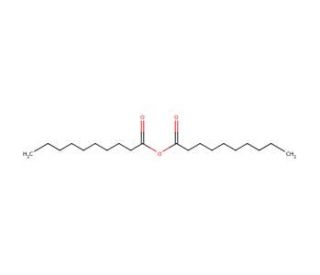

Decanoic anhydride (CAS 2082-76-0)
QUICK LINKS
Decanoic anhydride, a fatty acid derivative, is a versatile reagent employed in organic synthesis and materials research due to its acylation properties. Its primary application lies in acylating agents, where it introduces decanoyl groups to target molecules. This function has proven invaluable in modifying alcohols, amines, and other nucleophiles to produce esters and amides for further study. Researchers frequently use decanoic anhydride in the production of surface-active compounds, contributing to the design and understanding of surfactants and their behavior in emulsification and solubilization processes. Furthermore, its role in acylation makes it a crucial intermediate in synthesizing specialized esters, including biodegradable surfactants and lubricants, providing a window into designing more environmentally friendly materials. In polymer research, it′s utilized to modify natural polymers like cellulose or starch, altering their physical and chemical properties to enhance water resistance, flexibility, and thermal stability. This enhances the polymers′ performance in various coatings, adhesives, and films. Additionally, decanoic anhydride is used to investigate surface modification techniques for various substrates, shedding light on altering surface energy, hydrophobicity, and adhesion properties. Overall, this compound′s robust acylation capacity and stability have made it a staple in organic synthesis, polymer chemistry, and surface science, paving the way for innovative research applications.
Decanoic anhydride (CAS 2082-76-0) References
- Preparation of a Near-Infrared Ray Absorption Film from N-Phenylthiocarbamoyl Chitosan Derivative. | Nishida, S., et al. 2015. Int J Mol Sci. 16: 29093-102. PMID: 26690129
- Spatially resolved acyl transfer on surface by organo-catalytic scanning probe nanolithography (o-cSPL). | Botton, J., et al. 2018. Chem Sci. 9: 4280-4284. PMID: 29780559
- Prodrugs of PKC modulators show enhanced HIV latency reversal and an expanded therapeutic window. | Sloane, JL., et al. 2020. Proc Natl Acad Sci U S A. 117: 10688-10698. PMID: 32371485
- Self-Assembly of Functionalized Lipophilic Guanosines into Cation-Free Stacked Guanine-Quartets. | Campitiello, M., et al. 2021. J Org Chem. 86: 9970-9978. PMID: 34279932
- Vitamin E Acetate Determination in Vaping Liquids and Non-targeted Analysis of Vaping Emissions of Diluents of Concern, Vitamin E Acetate and Medium-Chain Triglycerides Oil. | Kosarac, I., et al. 2021. Front Chem. 9: 756745. PMID: 34966718
- Semi-synthetic puwainaphycin/minutissamide cyclic lipopeptides with improved antifungal activity and limited cytotoxicity. | Hájek, J., et al. 2021. RSC Adv. 11: 30873-30886. PMID: 35498921
- Ethanolic Extract of Artemisia vulgaris Leaf Promotes Apoptotic Cell Death in Non-Small-Cell Lung Carcinoma A549 Cells through Inhibition of the Wnt Signaling Pathway. | Tiwari, RK., et al. 2023. Metabolites. 13: PMID: 37110139
- The effect of macromolecular crowding degree on the self-assembly of fatty acid and lipid hydrolysis. | Sun, YL., et al. 2023. NPJ Sci Food. 7: 39. PMID: 37495579
- Cis-2-Decenoic Acid and Bupivacaine Delivered from Electrospun Chitosan Membranes Increase Cytokine Production in Dermal and Inflammatory Cell Lines. | Harrison, Z., et al. 2023. Pharmaceutics. 15: PMID: 37896236
- Deconvolution of multichannel LC-MS/MS chromatograms of glucosamine-phosphates: Evidence of a GlmS regulatory difference between Staphylococcus aureus and Enterococcus faecium. | Mishra, NR., et al. 2023. Talanta Open. 8: PMID: 38187186
Ordering Information
| Product Name | Catalog # | UNIT | Price | Qty | FAVORITES | |
Decanoic anhydride, 1 g | sc-214859 | 1 g | $32.00 | |||
Decanoic anhydride, 10 g | sc-214859A | 10 g | $160.00 |