
DDX60L Lentiviral Activation Particles (h): sc-413888-LAC
- Target species: human
- 200 µl of transduction-ready, high-titer CRISPR/dCas9 Lentiviral Activation Particles
- DDX60L Lentiviral Activation Particles (h) is a synergistic activation mediator (SAM) transcription activation system designed to specifically and efficiently upregulate gene expression via lentiviral transduction of cells
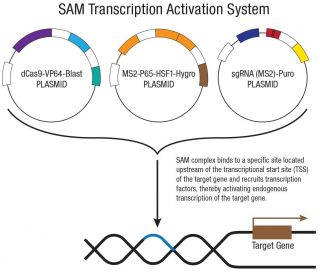
- DDX60L Lentiviral Activation Particles (h) contain the following SAM Activation elements: a deactivated Cas9 (dCas9) nuclease (D10A and N863A) fused to the transactivation domain VP64, an MS2-p65-HSF1 fusion protein and a target-specific 20 nt guide RNA. They also contain the blasticidin, hygromycin and puromycin resistance genes
- Upon transduction, the SAM complex binds to a site-specific region approximately 200-250 nt upstream of the transcriptional start site and provides robust recruitment of transcription factors for highly efficient gene activation
- gRNAs encoded by DDX60L Lentiviral Activation Plasmid (h) and DDX60L Lentiviral Activation Plasmid (h2) target distinct regulatory regions of the DDX60L promoter. One or both designs may be available

Ordering Information
| Product Name | Catalog # | UNIT | Price | Qty | FAVORITES | |
DDX60L Lentiviral Activation Particles (h) | sc-413888-LAC | 200 µl | $455.00 |
DDX60L (DExD/H-box helicase 60 like) encodes an interferon-stimulated RNA helicase implicated in innate antiviral defense through recognition and processing of viral RNA species. It is linked to cytosolic RNA sensing and type I interferon–associated transcriptional programs, functioning alongside RNA helicase and pattern-recognition receptor pathways that shape antiviral restriction. DDX60L activity has been studied in the context of interferon signaling dynamics, host–virus interactions, and regulation of RNA metabolism under inflammatory stress. Altered expression of interferon-stimulated genes including DDX60L is frequently observed across immune-mediated disorders and virus-associated tumor microenvironments, supporting its relevance as a research target for immunology and infection biology.
DDX60L Lentiviral Activation Particles (h) address this need by packaging the complete synergistic activation mediator (SAM) transcriptional activation system into transduction-ready, high-titer lentiviral particles, enabling efficient DDX60L upregulation across a broader range of human cell types.
DDX60L Lentiviral Activation Particles (h) deliver all functional components of the synergistic activation mediator (SAM) system via lentiviral transduction. The system comprises three particle preparations co-transduced into target cells: one encoding catalytically inactive dCas9 (D10A and N863A mutations) fused to the VP64 transactivation domain with a blasticidin resistance gene; one encoding the MS2-p65-HSF1 fusion protein with a hygromycin resistance gene; and one encoding a target-specific 20 nt sgRNA fused to two MS2 RNA aptamers with a puromycin resistance gene. Following lentiviral transduction and genomic integration of the expression cassettes, the SAM components are stably expressed and assemble at the target locus within the proximal promoter region upstream of the DDX60L transcriptional start site, where VP64, p65, and HSF1 act cooperatively to recruit endogenous transcriptional machinery and drive sustained upregulation of endogenous DDX60L expression. The use of nuclease-inactive dCas9 avoids the introduction of double-strand DNA breaks and preserves the native DDX60L genomic locus and regulatory architecture.
The lentiviral format offers several practical advantages: stable genomic integration supports heritable activation across cell divisions; high-titer particle preparations eliminate the need for in-house viral production; and compatibility with primary, non-dividing, and transfection-resistant cell types expands experimental accessibility. Successful transduction can be confirmed and enriched through triple antibiotic selection using puromycin, hygromycin, and blasticidin.
For Research Use Only. Not Intended for Diagnostic or Therapeutic Use.