
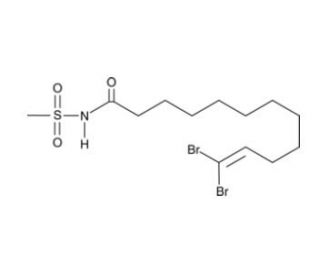

DDMS (CAS 206052-03-1)
QUICK LINKS
DDMS, or 2′,3′-Dideoxy-3′-thiomethylcytidine, with the CAS number 206052-03-1, is a synthetic analog of the nucleoside cytidine. It is characterized by the absence of hydroxyl groups at the 2′ and 3′ positions of the sugar moiety and the substitution of a thiomethyl group at the 3′ position. This structural modification renders DDMS a molecule of interest in the field of nucleic acid research, particularly in studies related to the inhibition of nucleic acid synthesis processes. The mechanism of action of DDMS primarily involves its incorporation into RNA or DNA during the synthesis phase, where it acts as a chain terminator. Due to its modified structure, once incorporated, DDMS prevents the addition of further nucleotides, effectively halting the elongation process of the nucleic acid chain. This property has been exploited in various non-clinical research settings to study the dynamics of nucleic acid synthesis and the potential regulatory mechanisms controlling these processes. Moreover, DDMS has been used to investigate the fidelity and mechanisms of various polymerases, as its incorporation can provide insights into the enzyme′s substrate specificity and reaction kinetics, contributing significantly to our understanding of genetic replication and transcription processes at a molecular level.
DDMS (CAS 206052-03-1) References
- Relative contributions of cyclooxygenase- and cytochrome P450 omega-hydroxylase-dependent pathways to hypoxic dilation of skeletal muscle resistance arteries. | Frisbee, JC., et al. 2001. J Vasc Res. 38: 305-14. PMID: 11455201
- Role of CYP epoxygenases in A2A AR-mediated relaxation using A2A AR-null and wild-type mice. | Nayeem, MA., et al. 2008. Am J Physiol Heart Circ Physiol. 295: H2068-78. PMID: 18805895
- High-salt diet enhances mouse aortic relaxation through adenosine A2A receptor via CYP epoxygenases. | Nayeem, MA., et al. 2009. Am J Physiol Regul Integr Comp Physiol. 296: R567-74. PMID: 19109366
- Modulation by salt intake of the vascular response mediated through adenosine A(2A) receptor: role of CYP epoxygenase and soluble epoxide hydrolase. | Nayeem, MA., et al. 2010. Am J Physiol Regul Integr Comp Physiol. 299: R325-33. PMID: 20427718
- CYP4A/20-HETE regulates ischemia-induced neovascularization via its actions on endothelial progenitor and preexisting endothelial cells. | Chen, L., et al. 2019. Am J Physiol Heart Circ Physiol. 316: H1468-H1479. PMID: 30951365
- Inhibition of 20-HETE production contributes to the vascular responses to nitric oxide. | Alonso-Galicia, M., et al. 1997. Hypertension. 29: 320-5. PMID: 9039122
- Cytochrome P-450 metabolites mediate norepinephrine-induced mitogenic signaling. | Uddin, MR., et al. 1998. Hypertension. 31: 242-7. PMID: 9453310
- Contribution of 20-HETE to the vasodilator actions of nitric oxide in renal arteries. | Alonso-Galicia, M., et al. 1998. Am J Physiol. 275: F370-8. PMID: 9729509
- The CYP4A/20‐HETE Axis Regulates Ischemia‐induced Neovascularization via Its Actions on Endothelial Progenitor and Preexisting Endothelial Cells. | Tang, Samantha, et al. 2019. The FASEB Journal. 33.S1: 677-2.
Ordering Information
| Product Name | Catalog # | UNIT | Price | Qty | FAVORITES | |
DDMS, 1 mg | sc-205289 | 1 mg | $112.00 | |||
DDMS, 5 mg | sc-205289A | 5 mg | $510.00 |