
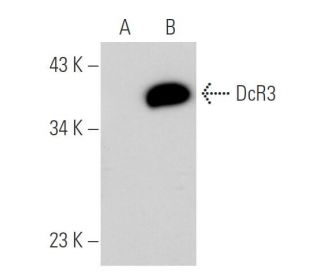


DcR3 Antibody (6D349): sc-70956
- DcR3 Antibody (6D349) is a mouse monoclonal IgG1 provided at 100 µg/ml
- raised against full length DcR3 of human origin
- recommended for detection of DcR3 of human origin by WB and IP
- At present, we have not yet completed the identification of the preferred secondary detection reagent(s) for DcR3 Antibody (6D349). This work is in progress.

QUICK LINKS
DcR3 Antibody (6D349) is a mouse monoclonal IgG1 antibody that detects DcR3 in human samples through western blotting (WB) and immunoprecipitation (IP) applications. DcR3, also known as decoy receptor 3, plays a crucial role in modulating the immune response by acting as a decoy for pro-apoptotic ligands such as TRAIL (TNF-related apoptosis-inducing ligand) and Fas ligand. By binding to these ligands, DcR3 prevents them from interacting with their respective death receptors, thereby inhibiting apoptosis in cells that might otherwise undergo programmed cell death. This function is particularly important in the context of cancer, where tumor cells often exploit this mechanism to evade immune surveillance and resist apoptosis, contributing to tumor progression and metastasis. Anti-DcR3 antibody (6D349) serves as an invaluable tool for researchers studying the complex interactions between tumor cells and the immune system, particularly given DcR3′s potential as a therapeutic target in cancer treatment.
Alexa Fluor® is a trademark of Molecular Probes Inc., OR., USA
LI-COR® and Odyssey® are registered trademarks of LI-COR Biosciences
DcR3 Antibody (6D349) References:
- DcR3 induces cell proliferation through MAPK signaling in chondrocytes of osteoarthritis. | Hayashi, S., et al. 2011. Osteoarthritis Cartilage. 19: 903-10. PMID: 21420502
- DcR3-TL1A signalling inhibits cytokine-induced proliferation of rheumatoid synovial fibroblasts. | Takahashi, M., et al. 2011. Int J Mol Med. 28: 423-7. PMID: 21537832
- DcR3 suppresses influenza virus-induced macrophage activation and attenuates pulmonary inflammation and lethality. | Huang, MT., et al. 2015. J Mol Med (Berl). 93: 1131-43. PMID: 25940317
- DcR3 induces epithelial-mesenchymal transition through activation of the TGF-β3/SMAD signaling pathway in CRC. | Liu, YP., et al. 2016. Oncotarget. 7: 77306-77318. PMID: 27764793
- DcR3, a new biomarker for sepsis, correlates with infection severity and procalcitonin. | Gao, L., et al. 2018. Oncotarget. 9: 10934-10944. PMID: 29541387
- DcR3 induces proliferation, migration, invasion, and EMT in gastric cancer cells via the PI3K/AKT/GSK-3β/β-catenin signaling pathway. | Ge, H., et al. 2018. Onco Targets Ther. 11: 4177-4187. PMID: 30050309
- Up-regulation of DcR3 in microbial toxins-stimulated HUVECs involves NF-κB signalling. | Hou, Y., et al. 2018. BMC Biochem. 19: 13. PMID: 30587127
- Serum decoy receptor 3 (DcR3): a promising biomarker for atopic asthma in children. | Kamal, A., et al. 2021. Immunol Res. 69: 568-575. PMID: 34383195
- DcR3-associated risk score: correlating better prognosis and enhanced predictive power in colorectal cancer. | Duan, Y., et al. 2024. Discov Oncol. 15: 233. PMID: 38890197
- Suppression of NF-κB and downstream XBP1 by DcR3 contributes to a decrease in antibody secretion. | Liu, PC., et al. 2025. J Immunol. 214: 72-84. PMID: 40073262
Ordering Information
| Product Name | Catalog # | UNIT | Price | Qty | FAVORITES | |
DcR3 Antibody (6D349) | sc-70956 | 100 µg/ml | $322.00 |