
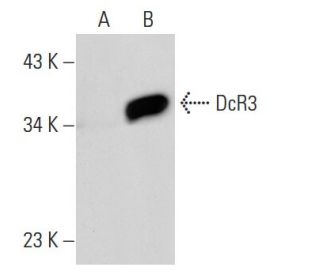


DcR3 Antibody (4H77): sc-70955
- DcR3 Antibody (4H77) is a mouse monoclonal IgG1 provided at 100 µg/ml
- raised against full length DcR3 of human origin
- recommended for detection of DcR3 of human origin by WB and IP
- At present, we have not yet completed the identification of the preferred secondary detection reagent(s) for DcR3 Antibody (4H77). This work is in progress.

QUICK LINKS
DcR3 Antibody (4H77) is a mouse monoclonal IgG1 antibody that detects DcR3 in human samples through western blotting (WB) and immunoprecipitation (IP) applications. DcR3, also known as decoy receptor 3, plays a crucial role in modulating the immune response by acting as a decoy for pro-apoptotic ligands such as TRAIL and FAS ligand. By binding to these ligands, DcR3 prevents them from interacting with their death domain-containing receptors, thereby inhibiting apoptosis in cells that would otherwise undergo programmed cell death. This function is particularly important in the context of cancer, where tumor cells often exploit this mechanism to evade immune surveillance and resist apoptosis, contributing to tumor progression and resistance to therapy. The ability of DcR3 to interfere with apoptotic signaling pathways highlights its potential as a therapeutic target and a biomarker for certain malignancies. Anti-DcR3 antibody (4H77) serves as an invaluable tool for researchers investigating the complex interplay between apoptosis and immune evasion in cancer biology.
Alexa Fluor® is a trademark of Molecular Probes Inc., OR., USA
LI-COR® and Odyssey® are registered trademarks of LI-COR Biosciences
DcR3 Antibody (4H77) References:
- TL1A is a TNF-like ligand for DR3 and TR6/DcR3 and functions as a T cell costimulator. | Migone, TS., et al. 2002. Immunity. 16: 479-92. PMID: 11911831
- DcR3 binds to ovarian cancer via heparan sulfate proteoglycans and modulates tumor cells response to platinum with corresponding alteration in the expression of BRCA1. | Connor, JP., et al. 2012. BMC Cancer. 12: 176. PMID: 22583667
- Decoy receptor 3 (DcR3) overexpression predicts the prognosis and pN2 in pancreatic head carcinoma. | Zhou, J., et al. 2014. World J Surg Oncol. 12: 52. PMID: 24597666
- The TL1A/DR3/DcR3 pathway in autoimmune rheumatic diseases. | Siakavellas, SI., et al. 2015. Semin Arthritis Rheum. 45: 1-8. PMID: 25887448
- Downregulation of DcR3 sensitizes hepatocellular carcinoma cells to TRAIL-induced apoptosis. | Liang, C., et al. 2017. Onco Targets Ther. 10: 417-428. PMID: 28176915
- DcR3 promotes hepatoma cell migration by downregulating E-cadherin expression. | Zhang, H., et al. 2017. Oncol Rep. 38: 377-383. PMID: 28560426
- TIPE Regulates DcR3 Expression and Function by Activating the PI3K/AKT Signaling Pathway in CRC. | Zhong, M., et al. 2020. Front Oncol. 10: 623048. PMID: 33718119
- The Role of Decoy Receptor DcR3 in Gastrointestinal Malignancy. | Lagou, S., et al. 2022. Cancer Diagn Progn. 2: 411-421. PMID: 35813013
- Research Progress of DcR3 in the Diagnosis and Treatment of Sepsis. | Su, J., et al. 2023. Int J Mol Sci. 24: PMID: 37629097
- Protective effects of DcR3-SUMO on lipopolysaccharide-induced inflammatory cells and septic mice. | Su, J., et al. 2024. Int J Biol Macromol. 275: 133703. PMID: 38986982
Ordering Information
| Product Name | Catalog # | UNIT | Price | Qty | FAVORITES | |
DcR3 Antibody (4H77) | sc-70955 | 100 µg/ml | $322.00 |