
Date published: 2026-4-24

1-800-457-3801

SCBT Portrait Logo
Seach Input

DC-SIGN Antibody (MR-1): sc-59157

4.0(1)
Write a reviewAsk a question

Datasheets
  • DC-SIGN Antibody (MR-1) is a mouse monoclonal IgG1 κ provided at 200 µg/ml
  • raised against immature myeloid monocyte-derived dendritic cells of human origin
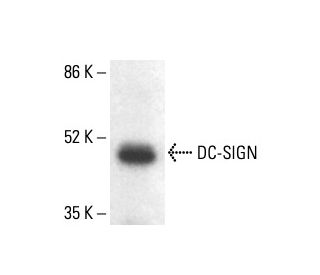
  • recommended for detection of DC-SIGN of human origin by WB, IP, IF and FCM
  • available conjugated to either phycoerythrin or FITC for IF, IHC(P) and FCM
  • At present, we have not yet completed the identification of the preferred secondary detection reagent(s) for DC-SIGN Antibody (MR-1). This work is in progress.
    Gene Editing Promo Banner

    QUICK LINKS

    SEE ALSO...

    DC-SIGN Antibody (MR-1) is a mouse monoclonal IgG1 antibody raised against human DC-SIGN (CD209), a crucial type II membrane protein central to immune system function. Anti-DC-SIGN antibody (MR-1) recognizes an epitope within the DC-SIGN immunogen sequence and demonstrates specificity for human samples through immunofluorescence (IF) and flow cytometry (FCM) applications. DC-SIGN exhibits sophisticated organization and function through its unique C-type lectin domain structure. This specialized domain enables DC-SIGN to recognize and bind various pathogens, most notably HIV-1, with remarkable specificity. DC-SIGN maintains precise expression patterns, appearing predominantly on dendritic cells - the professional antigen-presenting cells of the immune system that bridge innate and adaptive immunity by presenting antigens to T cells. The interaction between DC-SIGN and pathogens proves particularly significant in HIV-1 infection, where DC-SIGN not only facilitates initial pathogen capture but also enhances viral transmission to T cells, influencing disease progression. Through these diverse immunological functions, DC-SIGN (MR-1) antibody provides researchers with a valuable tool for investigating both normal dendritic cell function and viral immune evasion mechanisms in immunology and virology research.

    For Research Use Only. Not Intended for Diagnostic or Therapeutic Use.

    Alexa Fluor® is a trademark of Molecular Probes Inc., OR., USA

    LI-COR® and Odyssey® are registered trademarks of LI-COR Biosciences

    DC-SIGN Antibody (MR-1) References:

    1. Cyclic nucleotides promote monocyte differentiation toward a DC-SIGN+ (CD209) intermediate cell and impair differentiation into dendritic cells.  |  Giordano, D., et al. 2003. J Immunol. 171: 6421-30. PMID: 14662841
    2. Microbial stimulation fully differentiates monocytes to DC-SIGN/CD209(+) dendritic cells for immune T cell areas.  |  Cheong, C., et al. 2010. Cell. 143: 416-29. PMID: 21029863
    3. Role of DC-SIGN and L-SIGN receptors in HIV-1 vertical transmission.  |  da Silva, RC., et al. 2011. Hum Immunol. 72: 305-11. PMID: 21277928
    4. Glycan-based DC-SIGN targeting vaccines to enhance antigen cross-presentation.  |  van Kooyk, Y., et al. 2013. Mol Immunol. 55: 143-5. PMID: 23158834
    5. Association of Oligoadenylate Synthetase Gene Cluster and DC-SIGN (CD209) Gene Polymorphisms with Clinical Symptoms in Chikungunya Virus Infection.  |  Chaaithanya, IK., et al. 2016. DNA Cell Biol. 35: 44-50. PMID: 26398832
    6. Comparative binding and uptake of liposomes decorated with mannose oligosaccharides by cells expressing the mannose receptor or DC-SIGN.  |  Gao, H., et al. 2020. Carbohydr Res. 487: 107877. PMID: 31766009
    7. CD209/CD14+ Dendritic Cells Characterization in Rheumatoid and Psoriatic Arthritis Patients: Activation, Synovial Infiltration, and Therapeutic Targeting.  |  Marzaioli, V., et al. 2021. Front Immunol. 12: 722349. PMID: 35095831
    8. CSF-1-induced DC-SIGN+ macrophages are present in the ovarian endometriosis.  |  Xiaocui, L., et al. 2022. Reprod Biol Endocrinol. 20: 48. PMID: 35260161
    9. Mannobioside biomimetics that trigger DC-SIGN binding selectivity.  |  Herrera-González, I., et al. 2022. Chem Commun (Camb). 58: 12086-12089. PMID: 36219150
    10. CD209 signaling pathway as a biomarker for cisplatin chemotherapy response in small cell lung cancer.  |  Lin, A., et al. 2024. Genes Dis. 11: 101038. PMID: 38274378

    Ordering Information

    Product NameCatalog #UNITPriceQtyFAVORITES

    DC-SIGN Antibody (MR-1)

    sc-59157
    200 µg/ml
    $322.00

    DC-SIGN Antibody (MR-1): m-IgG Fc BP-HRP Bundle

    sc-551775
    200 µg Ab; 10 µg BP
    $361.00

    DC-SIGN Antibody (MR-1) FITC

    sc-59157 FITC
    200 µg/ml
    $336.00

    DC-SIGN Antibody (MR-1) PE

    sc-59157 PE
    200 µg/ml
    $349.00
