
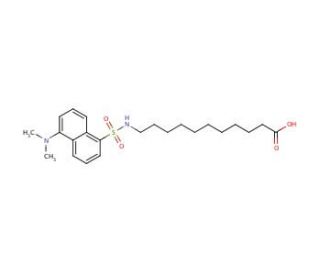

DAUDA (CAS 73025-02-2)
See product citations (1)
QUICK LINKS
DAUDA, with the CAS number 73025-02-2, is a fluorescent probe extensively used in biochemical and biophysical research to explore the dynamics and properties of lipid membranes. As a derivative of the anilinonaphthalene sulfonate family, DAUDA is particularly valued for its sensitivity to changes in the polarity of its environment, which makes it an effective tool for studying the hydrophobic regions of biological membranes. Upon insertion into lipid bilayers, DAUDA exhibits a marked increase in fluorescence intensity and a shift in its emission spectrum, phenomena that are attributed to the less polar environment within the membrane compared to aqueous surroundings. This shift in fluorescence properties enables researchers to monitor the behavior of lipid membranes under various conditions, such as changes in temperature, pH, or the presence of other biomolecules. Moreover, DAUDA has been utilized in the study of membrane fluidity and the organization of lipids within the bilayer, providing insights into the microscopic properties that govern membrane function and stability. Through these applications, DAUDA serves as a crucial tool in unraveling the complex interactions and dynamics of biological membranes, which are fundamental to understanding cellular processes at the molecular level.
DAUDA (CAS 73025-02-2) References
- Functional cavity dimensions of tear lipocalin. | Abduragimov, AR., et al. 2000. Curr Eye Res. 21: 824-32. PMID: 11120574
- Gene structure and M20T polymorphism of the Schistosoma mansoni Sm14 fatty acid-binding protein. Molecular, functioanl, and immunoprotection analysis. | Ramos, CR., et al. 2003. J Biol Chem. 278: 12745-51. PMID: 12551912
- Charge modification at conserved positively charged residues of fatty acid binding protein (FABP) from the giant liver fluke Fasciola gigantica: its effect on oligomerization and binding properties. | Janvilisri, T., et al. 2007. Mol Cell Biochem. 305: 95-102. PMID: 17594059
- A fluorescent fatty acid probe, DAUDA, selectively displaces two myristates bound in human serum albumin. | Wang, Y., et al. 2011. Protein Sci. 20: 2095-101. PMID: 21997768
- Characterizing the fatty acid binding site in the cavity of potassium channel KcsA. | Smithers, N., et al. 2012. Biochemistry. 51: 7996-8002. PMID: 22971149
- Zinc-induced oligomerization of zinc α2 glycoprotein reveals multiple fatty acid-binding sites. | Zahid, H., et al. 2016. Biochem J. 473: 43-54. PMID: 26487699
- Interaction of ceramides and tear lipocalin. | Glasgow, BJ. and Abduragimov, AR. 2018. Biochim Biophys Acta Mol Cell Biol Lipids. 1863: 399-408. PMID: 29331331
- Fatty Acid and Related Potassium Kv2 Channel Blockers: Toxicity and Physiological Actions on Mosquitoes. | Démares, F., et al. 2018. Insects. 9: PMID: 30388752
- Crystal structure of zinc-α2-glycoprotein in complex with a fatty acid reveals multiple different modes of protein-lipid binding. | Lau, AM., et al. 2019. Biochem J. 476: 2815-2834. PMID: 31506272
- Identification of diverse lipid-binding modes in the groove of zinc α2 glycoprotein reveals its functional versatility. | Zahid, H., et al. 2022. FEBS J. 289: 1876-1896. PMID: 34817923
Ordering Information
| Product Name | Catalog # | UNIT | Price | Qty | FAVORITES | |
DAUDA, 25 mg | sc-205288 | 25 mg | $42.00 | |||
DAUDA, 50 mg | sc-205288A | 50 mg | $80.00 |