
Date published: 2025-12-18

1-800-457-3801

SCBT Portrait Logo
Seach Input

DAPI (CAS 28718-90-3)

4.9(12)
Write a reviewAsk a question

See product citations (1211)

Alternate Names:
DAPI also known as 4,6-Diamidino-2-phenylindole Hydrochloride; DIHYDROCHLORIDE; 4′,6-DIAMIDINO-2-PHENYLINDOLE, 2HCL;4′,6-DIAMIDINO-2-PHENYLINDOLE DIHYDROCHLORIDE; 4′,6-DIAMIDINO-2-PHENYLINDOLE, HYDROCHLORIDE; 4′,6-DIAMIDINE-2′-PHENYLINDOLE DIHYDROCHLORIDE; 2-(4-AMIDINOPHENYL)-6-INDOLECARBAMIDINEDIHYDROCHLORIDE; 2-phenylindole-4′,6-dicarboxamidine dihydrohydrochloride (hydrate)
Application:
DAPI® is a cell-permeable DNA-binding dye preferential to adenine and thymine rich DNA and can be used for flow cytometry
CAS Number:
28718-90-3
Purity:
≥97%
Molecular Weight:
350.24
Molecular Formula:
C16H15N52HCl
For Research Use Only. Not Intended for Diagnostic or Therapeutic Use.
* Refer to Certificate of Analysis for lot specific data.

QUICK LINKS

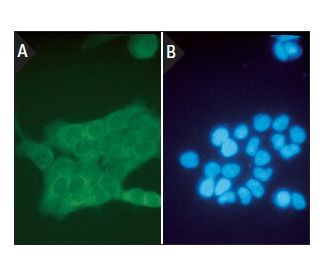
DAPI, or 4′,6-diamidino-2-phenylindole, is a fluorescent stain that binds strongly to the adenine-thymine rich regions in DNA, making it a valuable tool in cell biology and molecular genetics research. Its ability to emit a bright blue fluorescence upon binding to double-stranded DNA is exploited extensively in fluorescence microscopy and flow cytometry, providing a means to visualize and quantify nuclear and chromosomal material within cells. The mechanism by which DAPI operates involves intercalating between the bases of DNA, with a particular affinity for A-T clusters, where it aligns parallel to the DNA strands. This specific binding enhances its fluorescence emission at a peak wavelength of about 461 nm when excited by ultraviolet light. Researchers utilize DAPI to study cell cycle progression, apoptosis, and other cellular processes that involve changes in nuclear architecture. Its application extends to various techniques such as chromosome counting, nuclear localization studies, and the detection of DNA in cellular homogenates. DAPI′s ability to rapidly penetrate live or fixed cells without the need for harsh treatment makes it an indispensable tool in the arsenal of techniques for studying cellular morphology and genetic material under a variety of experimental conditions. This makes DAPI an essential stain in the field of cytogenetics and other research disciplines where detailed nuclear visualization is necessary.

For Research Use Only. Not Intended for Diagnostic or Therapeutic Use.

Alexa Fluor® is a trademark of Molecular Probes Inc., OR., USA

LI-COR® and Odyssey® are registered trademarks of LI-COR Biosciences


DAPI (CAS 28718-90-3) References

  1. High-speed chromosome sorting.  |  Gray, JW., et al. 1987. Science. 238: 323-9. PMID: 2443974
  2. Rapid Enrichment and Isolation of Polyphosphate-Accumulating Organisms Through 4'6-Diamidino-2-Phenylindole (DAPI) Staining With Fluorescence-Activated Cell Sorting (FACS).  |  Terashima, M., et al. 2020. Front Microbiol. 11: 793. PMID: 32425914
  3. Photophysical properties of DAPI in PVA films. Possibility of room temperature phosphorescence.  |  Alexander, E., et al. 2024. Anal Biochem. 689: 115498. PMID: 38423238
  4. Development of a fluorescent DNA sensor for dual detection of heavy metal ions utilising DAPI in distinct buffers.  |  Liu, Y., et al. 2024. Food Chem. 451: 139390. PMID: 38653103
  5. Mithramycin- and 4'-6-diamidino-2-phenylindole (DAPI)-DNA staining for fluorescence microspectrophotometric measurement of DNA in nuclei, plastids, and virus particles.  |  Coleman, AW., et al. 1981. J Histochem Cytochem. 29: 959-68. PMID: 6168681
  6. A direct comparison of procedures for the detection of mycoplasma in tissue culture.  |  Hessling, JJ., et al. 1980. J Immunol Methods. 38: 315-24. PMID: 7003019
  7. 4',6-Diamidino 2-phenylindole is a new reversible inhibitor of diamine oxidase and S-adenosyl-L-methionine decarboxylase from mammalian tissues.  |  Cubría, C., et al. 1993. Comp Biochem Physiol C Comp Pharmacol Toxicol. 105: 251-4. PMID: 8103731
  8. Flow cytometric detection of apoptosis: comparison of the assays of in situ DNA degradation and chromatin changes.  |  Hotz, MA., et al. 1994. Cytometry. 15: 237-44. PMID: 8187583
  9. Death-induced changes to the nuclear matrix: the use of anti-nuclear matrix antibodies to study agents of apoptosis.  |  Miller, T., et al. 1993. Biotechniques. 15: 1042-7. PMID: 8292336
  10. Estimation of total DNA in crude extracts of plant leaf tissue using 4',6-diamidino-2-phenylindole (DAPI) fluorometry.  |  Lee, LS. and Garnett, HM. 1993. J Biochem Biophys Methods. 26: 249-60. PMID: 8409197

Ordering Information

Product NameCatalog #UNITPriceQtyFAVORITES

DAPI, 10 mg

sc-3598
10 mg
$108.00

Hello When should i get DAPI at Nigdi, Pune.

Asked by: Pooj
For accurate availability and shipping information regarding of our chemical products, please contact our Customer Service group by phone, e-mail or live chat. Alternatively, please contact your local distributor, you can find their contact information here: https://www.scbt.com/scbt/resources/distributors
Answered by: Tech Service
Date published: 2017-06-26

We really like the DAPI, nice and bright. Does it have anti fade properties?

Asked by: Jz28sail
Thank you for your question. We are glad you have had success using sc-3598, DAPI. There are no inherent anti-fade properties in 4',6-Diamidino-2-phenylindole dihydrochloride (DAPI). We do offer two DAPI stain mounting media products which include anti-fade and anti-photobleaching properties: sc-24941, UltraCruz® Aqueous Mounting Medium with DAPI (https://www.scbt.com/scbt/product/ultracruz-mounting-medium?requestFrom=search) or sc-359850, UltraCruz® Hard-set Mounting Medium with DAPI (https://www.scbt.com/scbt/product/ultracruz-hard-set-mounting-medium?requestFrom=search).
Answered by: Chemical Support 5
Date published: 2017-04-13
  • y_2025, m_12, d_13, h_9CST
  • bvseo_bulk, prod_bvqa, vn_bulk_3.0.42
  • cp_1, bvpage1
  • co_hasquestionsanswers, tq_2
  • loc_en_US, sid_3598, prod, sort_[SortEntry(order=LAST_APPROVED_ANSWER_SUBMISSION_TIME, direction=DESCENDING)]
  • clientName_scbt
  • bvseo_sdk, java_sdk, bvseo-4.0.0
  • CLOUD, getContent, 106ms
  • QUESTIONS, PRODUCT
Rated 5 out of 5 by from FluorescenciaSe obtiene una muy buena tinción nuclear utilizando la concentración de 1ug/ml
Date published: 2022-04-11
Rated 5 out of 5 by from tres bienje suis très contente d'avoir acheter ce produit!!!
Date published: 2019-10-29
Rated 5 out of 5 by from Fluorescent imagingEffectively stained the nuclei of adipose-derived stem cells. Used as a concentration of 1ug/mL
Date published: 2019-03-06
Rated 5 out of 5 by from Great productI bought this 3-4 months ago and I used it in immunofluorescence and flow cytometry assays. Very good quality.
Date published: 2016-12-08
Rated 4 out of 5 by from DAPII have been using Dapi more than decades but recently moved to SantaCruz DAPI. works well
Date published: 2016-11-29
Rated 5 out of 5 by from Worked wellWorked well, used with RAW 264.7 + LPS/IFN Cell Lysate.
Date published: 2015-09-04
Rated 5 out of 5 by from Worked well in IFWorked well in IF
Date published: 2015-09-04
Rated 5 out of 5 by from Publishable data obtained using DAPI from SCBT (scPublishable data obtained using DAPI from SCBT (sc-3598) as a counterstain on S2 cells (PubMed ID 24603360). -SCBT Publication Review
Date published: 2015-05-11
  • y_2025, m_12, d_13, h_9
  • bvseo_bulk, prod_bvrr, vn_bulk_3.0.42
  • cp_1, bvpage1
  • co_hasreviews, tv_0, tr_12
  • loc_en_US, sid_3598, prod, sort_[SortEntry(order=SUBMISSION_TIME, direction=DESCENDING)]
  • clientName_scbt
  • bvseo_sdk, java_sdk, bvseo-4.0.0
  • CLOUD, getReviews, 8ms
  • REVIEWS, PRODUCT
DAPI is rated 4.9 out of 5 by 12.
  • y_2025, m_12, d_13, h_9
  • bvseo_bulk, prod_bvrr, vn_bulk_3.0.42
  • cp_1, bvpage1
  • co_hasreviews, tv_0, tr_12
  • loc_en_US, sid_3598, prod, sort_[SortEntry(order=SUBMISSION_TIME, direction=DESCENDING)]
  • clientName_scbt
  • bvseo_sdk, java_sdk, bvseo-4.0.0
  • CLOUD, getAggregateRating, 104ms
  • REVIEWS, PRODUCT