
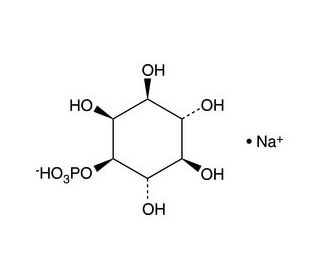

D-myo-Inositol-3-phosphate (sodium salt)
QUICK LINKS
D-myo-Inositol-3-phosphate (sodium salt) plays a pivotal role in cellular signaling pathways as a key intermediate in inositol phosphate metabolism. It serves as a precursor for the synthesis of various important signaling molecules, including inositol 1,4,5-trisphosphate (IP3) and phosphatidylinositol phosphates (PIPs). Upon extracellular stimuli, such as growth factors or neurotransmitters, phosphoinositide kinases phosphorylate D-myo-Inositol-3-phosphate to generate phosphatidylinositol 3,4,5-trisphosphate (PIP3), which acts as a second messenger regulating diverse cellular processes. Additionally, D-myo-Inositol-3-phosphate can undergo dephosphorylation to yield myo-inositol, a precursor for the synthesis of phosphoinositides, glycerophospholipids, and inositol phosphates. In research, this chemical is widely utilized to investigate the signaling networks governed by phosphoinositides and their downstream effectors. Researchers employ various techniques, such as mass spectrometry, fluorescence imaging, and biochemical assays, to explain the precise roles of D-myo-Inositol-3-phosphate in cell signaling and its impact on cellular physiology. Furthermore, studies focus on understanding the dysregulation of inositol phosphate metabolism in pathological conditions, including cancer, neurodegenerative disorders, and metabolic diseases, to uncover potential targets for intervention. By unraveling the mechanisms of action of D-myo-Inositol-3-phosphate, sodium salt, scientists aim to deepen our understanding of cell signaling dynamics and develop novel strategies for treating various human diseases.
D-myo-Inositol-3-phosphate (sodium salt) References
- Inositol phosphate biochemistry. | Majerus, PW. 1992. Annu Rev Biochem. 61: 225-50. PMID: 1323235
- A limitation of the continuous spectrophotometric assay for the measurement of myo-inositol-1-phosphate synthase activity. | Huang, X. and Hernick, M. 2011. Anal Biochem. 417: 228-32. PMID: 21729692
- Recombinant expression of a functional myo-inositol-1-phosphate synthase (MIPS) in Mycobacterium smegmatis. | Huang, X. and Hernick, M. 2015. Protein J. 34: 380-90. PMID: 26420670
- Release of Ca2+ from a nonmitochondrial intracellular store in pancreatic acinar cells by inositol-1,4,5-trisphosphate. | Streb, H., et al. Nature. 306: 67-9. PMID: 6605482
- Inositol trisphosphate and calcium signalling. | Berridge, MJ. 1993. Nature. 361: 315-25. PMID: 8381210
- Regulation of phosphoinositide phospholipases by hormones, neurotransmitters, and other agonists linked to G proteins. | Exton, JH. 1996. Annu Rev Pharmacol Toxicol. 36: 481-509. PMID: 8725399
- Structure and function of inositol 1,4,5-trisphosphate receptor. | Yoshida, Y. and Imai, S. 1997. Jpn J Pharmacol. 74: 125-37. PMID: 9243320
Ordering Information
| Product Name | Catalog # | UNIT | Price | Qty | FAVORITES | |
D-myo-Inositol-3-phosphate (sodium salt), 100 µg | sc-221511 | 100 µg | $50.00 | |||
D-myo-Inositol-3-phosphate (sodium salt), 500 µg | sc-221511A | 500 µg | $176.00 |