
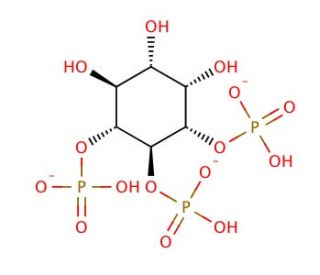

D-myo-Inositol-3,4,5-triphosphate (sodium salt)
QUICK LINKS
D-myo-Inositol-3,4,5-triphosphate (sodium salt) is an intriguing chemical structure in the study of cellular signaling pathways. Its triphosphate configuration at the 3, 4, and 5 positions of the myo-inositol ring represents a less commonly explored form within the inositol phosphate family, distinguishing it from the widely studied D-myo-Inositol-1,4,5-triphosphate. The unique positioning of its phosphate groups presents novel opportunities to study intracellular signaling and regulatory mechanisms. Research into D-myo-Inositol-3,4,5-triphosphate often involves understanding its role as a second messenger in cellular signal transduction. While its exact receptor and pathway specificity remain areas of active investigation, researchers use this compound to examine how alternative inositol phosphate patterns affect cellular calcium mobilization and other downstream processes. It has been instrumental in elucidating the structural basis for inositol phosphate-receptor interactions, revealing distinctions in how different isomers are recognized by specific proteins. Further research has indicated that this specific triphosphate may influence membrane-associated signaling complexes, highlighting the importance of precise phosphorylation patterns in defining signal specificity. By probing the enzymatic pathways responsible for its formation and degradation, scientists can gain insights into broader phosphoinositide metabolism, offering a window into the regulation of cellular processes such as proliferation, migration, and vesicular trafficking.
D-myo-Inositol-3,4,5-triphosphate (sodium salt) References
- Selective recognition of inositol phosphates by subtypes of the inositol trisphosphate receptor. | Nerou, EP., et al. 2001. Biochem J. 355: 59-69. PMID: 11256949
- Inositol phosphate biochemistry. | Majerus, PW. 1992. Annu Rev Biochem. 61: 225-50. PMID: 1323235
- Release of Ca2+ from a nonmitochondrial intracellular store in pancreatic acinar cells by inositol-1,4,5-trisphosphate. | Streb, H., et al. Nature. 306: 67-9. PMID: 6605482
- Inositol trisphosphate and calcium signalling. | Berridge, MJ. 1993. Nature. 361: 315-25. PMID: 8381210
- Regulation of phosphoinositide phospholipases by hormones, neurotransmitters, and other agonists linked to G proteins. | Exton, JH. 1996. Annu Rev Pharmacol Toxicol. 36: 481-509. PMID: 8725399
- Structure and function of inositol 1,4,5-trisphosphate receptor. | Yoshida, Y. and Imai, S. 1997. Jpn J Pharmacol. 74: 125-37. PMID: 9243320
Ordering Information
| Product Name | Catalog # | UNIT | Price | Qty | FAVORITES | |
D-myo-Inositol-3,4,5-triphosphate (sodium salt), 100 µg | sc-221512 | 100 µg | $65.00 | |||
D-myo-Inositol-3,4,5-triphosphate (sodium salt), 500 µg | sc-221512A | 500 µg | $390.00 |