
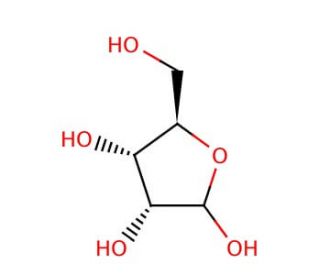

D-(−)-Ribose (CAS 50-69-1)
See product citations (1)
QUICK LINKS
D-(−)-Ribose is a simple sugar and carbohydrate featuring the molecular formula C5H10O5. This compound is distinguished by its role as a building block in various metabolic pathways, prominently serving as the sugar moiety of ATP (adenosine triphosphate). ATP is a critical energy carrier in cells, driving numerous biological processes. D-Ribose′s structure, characterized by its linear form and the presence of five carbon atoms each bearing a hydroxyl group, contributes to its fundamental role in biochemistry, particularly in the synthesis and structure of nucleic acids and energy molecules. The compound exhibits a melting point of approximately 95°C, highlighting its stability under standard laboratory conditions. It is available in different purities, with specifications indicating its usage in scientific research, especially in studies related to cellular energy metabolism and the determination of pentokinase activity. This sugar′s importance extends to various biochemical applications, including its use as a substrate for enzymatic reactions and in the synthesis of critical biomolecules
D-(−)-Ribose (CAS 50-69-1) References
- D-Ribose as a supplement for cardiac energy metabolism. | Pauly, DF. and Pepine, CJ. 2000. J Cardiovasc Pharmacol Ther. 5: 249-58. PMID: 11150394
- D-ribose induces cellular protein glycation and impairs mouse spatial cognition. | Han, C., et al. 2011. PLoS One. 6: e24623. PMID: 21966363
- D-ribose in glycation and protein aggregation. | Wei, Y., et al. 2012. Biochim Biophys Acta. 1820: 488-94. PMID: 22274132
- Practical synthesis of 4'-thioribonucleosides starting from D-ribose. | Minakawa, N. and Matsuda, A. 2014. Curr Protoc Nucleic Acid Chem. 59: 14.12.1-19. PMID: 25501591
- d-Ribose induced glycoxidative insult to hemoglobin protein: An approach to spot its structural perturbations. | Siddiqui, Z., et al. 2018. Int J Biol Macromol. 112: 134-147. PMID: 29378270
- D-ribose induces nephropathy through RAGE-dependent NF-κB inflammation. | Hong, J., et al. 2018. Arch Pharm Res. 41: 838-847. PMID: 30101366
- Origin of Coding RNA from Random-Sequence RNA. | Banfalvi, G. 2019. DNA Cell Biol. 38: 223-228. PMID: 30638405
- D-ribose increases triglyceride via upregulation of DGAT in the liver. | Chen, Y., et al. 2019. Sci China Life Sci. 62: 858-861. PMID: 31049804
- The furanosidic scaffold of d-ribose: a milestone for cell life. | Del-Corso, A., et al. 2019. Biochem Soc Trans. 47: 1931-1940. PMID: 31697320
- d-Ribose Catabolism in Archaea: Discovery of a Novel Oxidative Pathway in Haloarcula Species. | Johnsen, U., et al. 2020. J Bacteriol. 202: PMID: 31712277
- Synthetic Supramolecular Host for D-(-)-Ribose: Ratiometric Fluorescence Response via Multivalent Lectin-Carbohydrate Interactions. | Fernandes, RS. and Dey, N. 2022. Chembiochem. 23: e202200044. PMID: 35429209
- Nonenzymatic glycosylation of isolated human immunoglobulin-G by D-ribose. | Ahmad, S., et al. 2022. Cell Biochem Funct. 40: 526-534. PMID: 35707967
- D-ribose and deoxy-D-ribose induce apoptosis in human quiescent peripheral blood mononuclear cells. | Barbieri, D., et al. 1994. Biochem Biophys Res Commun. 201: 1109-16. PMID: 8024552
Ordering Information
| Product Name | Catalog # | UNIT | Price | Qty | FAVORITES | |
D-(−)-Ribose, 5 g | sc-221458 | 5 g | $26.00 | |||
D-(−)-Ribose, 25 g | sc-221458A | 25 g | $58.00 | |||
D-(−)-Ribose, 100 g | sc-221458B | 100 g | $112.00 | |||
D-(−)-Ribose, 250 g | sc-221458C | 250 g | $235.00 | |||
D-(−)-Ribose, 1 kg | sc-221458D | 1 kg | $612.00 | |||
D-(−)-Ribose, 5 kg | sc-221458E | 5 kg | $1224.00 | |||
D-(−)-Ribose, 10 kg | sc-221458F | 10 kg | $2040.00 |