
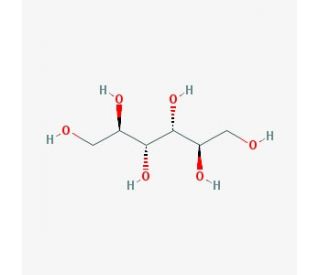

D(−)Mannitol (CAS 69-65-8)
See product citations (2)
QUICK LINKS
D(−)Mannitol is a sugar alcohol that can be used as an inert osmotic control substance. The uptake and phosphorylation of the compound is catalyzed by the mannitol-specific phosphoenolpyruvate-dependent phosphotransferase systems (PTS). D(−)Mannitol can interact with neutrophils and monocytes. Experiments have shown that it is able to decrease neutrophil apoptosis in vitro. The compound has been used in studies as a stimulator of cecal microbial growth and cellulolytic activity in rabbits. It has been observed that D(−)Mannitol can lower the fat digestibility and body fat accumulation in both normal and cecectomized rats, as well as upregulate monocyte HLA-DR, monocyte and neutrophil CD11b. Studies show that the D(−)Mannitol operon is repressed by the transcription factor, D(−)Mannitol operon repressor (MtlR) in Escherichia coli.
D(−)Mannitol (CAS 69-65-8) References
- Mannitol upregulates monocyte HLA-DR, monocyte and neutrophil CD11b, and inhibits neutrophil apoptosis. | Turina, M., et al. 2008. Inflammation. 31: 74-83. PMID: 17957461
- Effects of L-lactate and D-mannitol on gamma-hydroxybutyrate toxicokinetics and toxicodynamics in rats. | Wang, Q., et al. 2008. Drug Metab Dispos. 36: 2244-51. PMID: 18719239
- Mannitol lowers fat digestibility and body fat accumulation in both normal and cecectomized rats. | Nishiyama, A., et al. 2009. J Nutr Sci Vitaminol (Tokyo). 55: 242-51. PMID: 19602832
- The mannitol operon repressor MtlR belongs to a new class of transcription regulators in bacteria. | Tan, K., et al. 2009. J Biol Chem. 284: 36670-36679. PMID: 19840941
- Effect of D-mannitol on feed digestion and cecotrophic system in rabbits. | Hanieh, H. and Sakaguchi, E. 2009. Anim Sci J. 80: 157-62. PMID: 20163585
- Influence of mannitol concentration on the physicochemical, mechanical and pharmaceutical properties of lyophilised mannitol. | Kaialy, W., et al. 2016. Int J Pharm. 510: 73-85. PMID: 27242312
- Enhanced mannitol biosynthesis by the fruit origin strain Fructobacillus tropaeoli CRL 2034. | Ruiz Rodríguez, LG., et al. 2017. Appl Microbiol Biotechnol. 101: 6165-6177. PMID: 28674850
- Mannitol and the blood-labyrinth barrier. | Le, TN. and Blakley, BW. 2017. J Otolaryngol Head Neck Surg. 46: 66. PMID: 29228990
- Identification and pathogenicity analysis of Streptococcus equinus FMD1, a beta-hemolytic strain isolated from forest musk deer lung. | Zhao, W., et al. 2020. J Vet Med Sci. 82: 172-176. PMID: 31902837
- Assessment of the application for renewal of the authorisation of Pediococcus pentosaceus DSM 16244 as a feed additive for all animal species. | , ., et al. 2020. EFSA J. 18: e06166. PMID: 32874341
- Effects of Volume Replacement for Urinary Losses from Mannitol Diuresis on Brain Water in Normal Rats. | Gottschalk, A. and Toung, TJK. 2021. Neurocrit Care. 35: 24-29. PMID: 33123951
- Silver Cluster-Porphyrin-Assembled Materials as Advanced Bioprotective Materials for Combating Superbacteria. | Cao, M., et al. 2022. Adv Sci (Weinh). 9: e2103721. PMID: 34761563
- Highly selective generation of singlet oxygen from dioxygen with atomically dispersed catalysts. | Ma, W., et al. 2022. Chem Sci. 13: 5606-5615. PMID: 35694341
- Melatonin Alleviates Chilling Injury Symptom Development in Mango Fruit by Maintaining Intracellular Energy and Cell Wall and Membrane Stability. | Bhardwaj, R., et al. 2022. Front Nutr. 9: 936932. PMID: 35845799
- Evaluation of Time Consolidation Effect of Pharmaceutical Powders. | Thool, P., et al. 2022. Pharm Res. 39: 3345-3357. PMID: 36180609
Ordering Information
| Product Name | Catalog # | UNIT | Price | Qty | FAVORITES | |
D(−)Mannitol, 50 g | sc-203020A | 50 g | $10.00 | |||
D(−)Mannitol, 100 g | sc-203020 | 100 g | $19.00 |