
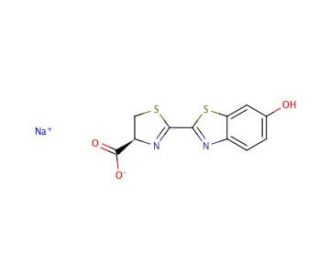

D-Luciferin sodium salt (CAS 103404-75-7)
QUICK LINKS
D-Luciferin sodium salt serves as a pivotal substrate in a biochemical assay where its oxidation by the enzyme luciferase culminates in the emission of bioluminescence, a process instrumental in visualizing and quantifying gene expression. This system has been ingeniously integrated into research across a diverse array of biological models including plants, bacteria, and mammalian cells, facilitating the exploration of genetic regulatory mechanisms, protein-protein interactions, and cellular signaling pathways. The inherent sensitivity of this luminescent reporter gene system is dramatically enhanced due to its virtually background-free nature, making it exquisitely suited for the detection of even the most subtle levels of gene expression. Such precision is invaluable in studies where accurate quantification is imperative, establishing D-Luciferin sodium salt′s role as a cornerstone in the toolkit of molecular biology and genetic engineering research, enabling scientists to probe the complexities of life at a molecular level with unparalleled clarity and sensitivity.
D-Luciferin sodium salt (CAS 103404-75-7) References
- Bioluminescent monitoring of intracellular ATP during fermentation. | Funabashi, H., et al. 1999. Luminescence. 14: 291-6. PMID: 10602297
- Enhanced firefly bioluminescent assay of adenosine 5'-triphosphate using liposomes containing cationic cholesterols. | Nakata, N. and Kamidate, T. 2001. Luminescence. 16: 263-9. PMID: 11512141
- Real-time in vivo imaging of transgenic bioluminescent blood stages of rodent malaria parasites in mice. | Franke-Fayard, B., et al. 2006. Nat Protoc. 1: 476-85. PMID: 17406270
- Rational design of novel red-shifted BRET pairs: Platforms for real-time single-chain protease biosensors. | Gammon, ST., et al. 2009. Biotechnol Prog. 25: 559-69. PMID: 19330851
- Identification of inhibitors of ABCG2 by a bioluminescence imaging-based high-throughput assay. | Zhang, Y., et al. 2009. Cancer Res. 69: 5867-75. PMID: 19567678
- A portable bioluminescence engineered cell-based biosensor for on-site applications. | Roda, A., et al. 2011. Biosens Bioelectron. 26: 3647-53. PMID: 21388801
- Quantum yields and quantitative spectra of firefly bioluminescence with various bivalent metal ions. | Wang, Y., et al. 2011. Photochem Photobiol. 87: 846-52. PMID: 21477077
- Identification and synthesis of substituted pyrrolo[2,3-d]pyrimidines as novel firefly luciferase inhibitors. | Liu, Y., et al. 2012. Bioorg Med Chem. 20: 5473-82. PMID: 22898255
- Influence of bioluminescence imaging dynamics by D-luciferin uptake and efflux mechanisms. | Zhang, Y., et al. 2012. Mol Imaging. 11: 499-506. PMID: 23084250
- Bioengineered bioluminescent magnetotactic bacteria as a powerful tool for chip-based whole-cell biosensors. | Roda, A., et al. 2013. Lab Chip. 13: 4881-9. PMID: 24193113
- Assessing Extracellular ATP as Danger Signal In Vivo: The pmeLuc System. | Di Virgilio, F., et al. 2016. Methods Mol Biol. 1417: 115-29. PMID: 27221485
- Bioluminescence-Based Tumor Quantification Method for Monitoring Tumor Progression and Treatment Effects in Mouse Lymphoma Models. | Cosette, J., et al. 2016. J Vis Exp.. PMID: 27501019
- Detection of Extracellular ATP in the Tumor Microenvironment, Using the pmeLUC Biosensor. | De Marchi, E., et al. 2020. Methods Mol Biol. 2041: 183-195. PMID: 31646489
- Ultrasmall CuS@BSA nanoparticles with mild photothermal conversion synergistically induce MSCs-differentiated fibroblast and improve skin regeneration. | Xiao, Y., et al. 2020. Theranostics. 10: 1500-1513. PMID: 32042318
- Animal model of intrahepatic metastasis of hepatocellular carcinoma: establishment and characteristic. | Li, X., et al. 2020. Sci Rep. 10: 15199. PMID: 32939004
Ordering Information
| Product Name | Catalog # | UNIT | Price | Qty | FAVORITES | |
D-Luciferin sodium salt, 200 µg | sc-207479B | 200 µg | $56.00 | |||
D-Luciferin sodium salt, 5 mg | sc-207479 | 5 mg | $138.00 | |||
D-Luciferin sodium salt, 100 mg | sc-207479A | 100 mg | $231.00 | |||
D-Luciferin sodium salt, 250 mg | sc-207479C | 250 mg | $418.00 | |||
D-Luciferin sodium salt, 1 g | sc-207479D | 1 g | $917.00 |