
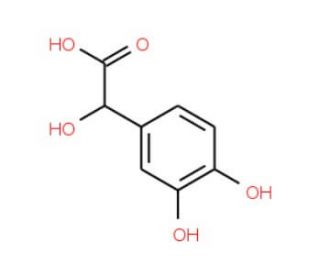

D,L-3,4-Dihydroxymandelic Acid (CAS 775-01-9)
QUICK LINKS
D,L-3,4-Dihydroxymandelic Acid, also known as 3,4-Dihydroxymandelic acid (3,4-DHM), is a naturally occurring compound present in diverse applications in scientific research. As a metabolite of dopamine, it serves as a intermediate in the synthesis of various compounds. The unique properties of D,L-3,4-Dihydroxymandelic Acid make it an invaluable tool for researchers in the fields of biochemistry, physiology, and pharmacology. D,L-3,4-Dihydroxymandelic Acid finds extensive use in scientific research across various domains. It acts as an intermediate in the synthesis of neurotransmitters and hormones. Additionally, its potential role in dopamine level regulation and neuronal activity modulation has been investigated. Although the precise mechanism of action of D,L-3,4-Dihydroxymandelic Acid remains incompletely understood, it is believed to function as an inhibitor of the enzyme tyrosine hydroxylase, responsible for converting tyrosine into dopamine. Moreover, it may also influence the activity of other enzymes involved in neurotransmitter and hormone synthesis.
D,L-3,4-Dihydroxymandelic Acid (CAS 775-01-9) References
- Identification and characterization of pvuA, a gene encoding the ferric vibrioferrin receptor protein in Vibrio parahaemolyticus. | Funahashi, T., et al. 2002. J Bacteriol. 184: 936-46. PMID: 11807053
- 3,4-Dihydroxymandelic acid, a noradrenalin metabolite with powerful antioxidative potential. | Ley, JP., et al. 2002. J Agric Food Chem. 50: 5897-902. PMID: 12358456
- Metabolism of l-Tyrosine to 4-Hydroxybenzaldehyde and 3-Bromo-4-Hydroxybenzaldehyde by Chloroplast-containing Fractions of Odonthalia floccosa (Esp.) Falk. | Manley, SL. and Chapman, DJ. 1979. Plant Physiol. 64: 1032-8. PMID: 16661087
- Development of a novel fluorometric assay for nitric oxide utilizing sesamol and its application to analysis of nitric oxide-releasing drugs. | Abe, S., et al. 2010. Luminescence. 25: 456-62. PMID: 19924673
- Mechanism of catalytic ozonation in Fe ₂O₃/Al ₂O₃@SBA-15 aqueous suspension for destruction of ibuprofen. | Bing, J., et al. 2015. Environ Sci Technol. 49: 1690-7. PMID: 25564945
- Enhanced Fenton Catalytic Efficiency of γ-Cu-Al₂O₃ by σ-Cu²⁺-Ligand Complexes from Aromatic Pollutant Degradation. | Lyu, L., et al. 2015. Environ Sci Technol. 49: 8639-47. PMID: 26101896
- Manganese(II)-dependent extradiol-cleaving catechol dioxygenase from Arthrobacter globiformis CM-2. | Whiting, AK., et al. 1996. Biochemistry. 35: 160-70. PMID: 8555170
Ordering Information
| Product Name | Catalog # | UNIT | Price | Qty | FAVORITES | |
D,L-3,4-Dihydroxymandelic Acid, 1 g | sc-207486 | 1 g | $453.00 |