
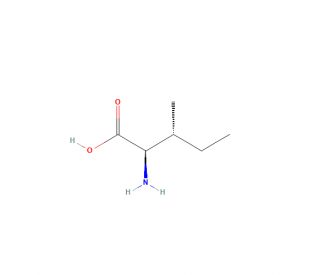

D-Isoleucine (CAS 319-78-8)
QUICK LINKS
D-Isoleucine, an essential amino acid, plays a role in the proper functioning of the body. As a significant component of proteins, it participates in numerous metabolic processes. Its importance lies in muscle tissue development, energy production, and the synthesis of hormones, enzymes, and other proteins. Natural sources of D-Isoleucine include meat, fish, eggs, dairy products, nuts, and legumes. Additionally, it is available as a dietary supplement. D-Isoleucine finds extensive applications in scientific research. Its involvement spans protein structure, function, metabolism, and cell signaling pathways. Moreover, it contributes to the study of enzyme activities, metabolic pathways, genetic engineering, and gene expression. The synthesis of proteins and other molecules, as well as energy production, relies on D-Isoleucine. It also contributes to the metabolism of fats and carbohydrates and plays a role in the production of hormones, enzymes, and the regulation of cell growth and differentiation.
D-Isoleucine (CAS 319-78-8) References
- Asymmetric, anti-selective scandium-catalyzed Sakurai additions to glyoxyamide. Applications to the syntheses of N-boc D-alloisoleucine and D-isoleucine. | Evans, DA., et al. 2006. Org Lett. 8: 2071-3. PMID: 16671784
- Neuronal D-serine and glycine release via the Asc-1 transporter regulates NMDA receptor-dependent synaptic activity. | Rosenberg, D., et al. 2013. J Neurosci. 33: 3533-44. PMID: 23426681
- Efficient synthesis of D-branched-chain amino acids and their labeled compounds with stable isotopes using D-amino acid dehydrogenase. | Akita, H., et al. 2014. Appl Microbiol Biotechnol. 98: 1135-43. PMID: 23661083
- Metabolic footprint analysis uncovers strain specific overflow metabolism and D-isoleucine production of Staphylococcus aureus COL and HG001. | Dörries, K. and Lalk, M. 2013. PLoS One. 8: e81500. PMID: 24312553
- Spectrophotometric assay of D-isoleucine using an artificially created D-amino acid dehydrogenase. | Akita, H., et al. 2014. Biotechnol Lett. 36: 2245-8. PMID: 24966047
- Enantioselective inhibition of d-serine transport by (S)-ketamine. | Singh, NS., et al. 2015. Br J Pharmacol. 172: 4546-4559. PMID: 26140427
- Structure-Based Engineering of an Artificially Generated NADP+-Dependent d-Amino Acid Dehydrogenase. | Hayashi, J., et al. 2017. Appl Environ Microbiol. 83: PMID: 28363957
- Substrate specificity of duckling hepatic and renal D-amino acid oxidase. | Elkin, RG. and Lyons, ML. 1988. Poult Sci. 67: 851-4. PMID: 2900508
- Development and validation of a rapid, selective, and sensitive LC-MS/MS method for simultaneous determination of D- and L-amino acids in human serum: application to the study of hepatocellular carcinoma. | Han, M., et al. 2018. Anal Bioanal Chem. 410: 2517-2531. PMID: 29492623
- Artificial Thermostable D-Amino Acid Dehydrogenase: Creation and Application. | Akita, H., et al. 2018. Front Microbiol. 9: 1760. PMID: 30123202
- The Revised Structure of the Cyclic Octapeptide Surugamide A. | Matsuda, K., et al. 2019. Chem Pharm Bull (Tokyo). 67: 476-480. PMID: 31061373
- Synthesis and activity of isoleucine sulfonamide derivatives as novel botulinum neurotoxin serotype A light chain inhibitors. | Thompson, JC., et al. 2020. Bioorg Med Chem. 28: 115659. PMID: 32828426
- Biogenetic origin of the D-isoleucine and N-methyl-L-alloisoleucine residues in the actinomycins. | Yajima, T., et al. 1976. Antimicrob Agents Chemother. 9: 224-32. PMID: 57739
Ordering Information
| Product Name | Catalog # | UNIT | Price | Qty | FAVORITES | |
D-Isoleucine, 250 mg | sc-479078 | 250 mg | $458.00 | |||
D-Isoleucine, 1 g | sc-479078A | 1 g | $1530.00 |