
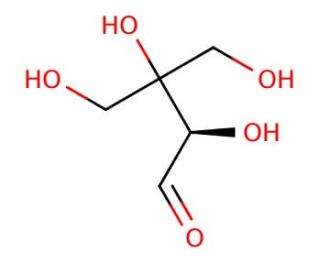

D-Apiose (CAS 639-97-4)
QUICK LINKS
D-Apiose is a sugar involved in the synthesis of plant cell wall polysaccharides, particularly in the pectic substance apiogalacturonan. In research, D-apiose is of interest to plant biologists and chemists who study its role in plant growth and development, as well as its contribution to the structural integrity and bioactivity of cell walls. As a relatively rare sugar, it provides a model for understanding the biosynthesis and function of unusual sugars in plants. Investigations involving D-apiose also delve into its incorporation into glycosylated natural products, which are significant in plant defense mechanisms and signaling. Furthermore, researchers in the field of synthetic chemistry explore the chemical synthesis of D-apiose for the purpose of creating apiogalacturonan analogs, which can be used to study the interactions between cell wall components and other biological molecules.
D-Apiose (CAS 639-97-4) References
- Proof for the origin of the branch hydroxymethyl carbon of D-apiose from carbon 3 of D-glucuronic acid. | Kelleher, WJ., et al. 1972. FEBS Lett. 22: 203-204. PMID: 11946597
- Structural studies of the pectic polysaccharide from duckweed Lemna minor L. | Golovchenko, VV., et al. 2002. Phytochemistry. 60: 89-97. PMID: 11985856
- Depletion of UDP-D-apiose/UDP-D-xylose synthases results in rhamnogalacturonan-II deficiency, cell wall thickening, and cell death in higher plants. | Ahn, JW., et al. 2006. J Biol Chem. 281: 13708-13716. PMID: 16549428
- Developmental Control of Apiogalacturonan Biosynthesis and UDP-Apiose Production in a Duckweed. | Longland, JM., et al. 1989. Plant Physiol. 90: 972-6. PMID: 16666907
- Isotope Probing of the UDP-Apiose/UDP-Xylose Synthase Reaction: Evidence of a Mechanism via a Coupled Oxidation and Aldol Cleavage. | Eixelsberger, T., et al. 2017. Angew Chem Int Ed Engl. 56: 2503-2507. PMID: 28102965
- Functional assignment of multiple catabolic pathways for D-apiose. | Carter, MS., et al. 2018. Nat Chem Biol. 14: 696-705. PMID: 29867142
- UHPLC-HRMS based flavonoid profiling of the aerial parts of Chenopodium foliosum Asch. (Amaranthaceae). | Kokanova-Nedialkova, Z. and Nedialkov, PT. 2021. Nat Prod Res. 35: 3336-3340. PMID: 31711317
- Deciphering the enzymatic mechanism of sugar ring contraction in UDP-apiose biosynthesis. | Savino, S., et al. 2019. Nat Catal. 2: 1115-1123. PMID: 31844840
- The biosynthesis of D-apiose in Lemna minor. | Picken, JM. and Mendicino, J. 1967. J Biol Chem. 242: 1629-34. PMID: 4290249
- Isolation and partial characterization of apiogalacturonans from the cell wall of Lemna minor. | Hart, DA. and Kindel, PK. 1970. Biochem J. 116: 569-79. PMID: 4314131
- D-apiose reductase from Aerobacter aerogenes. | Neal, DL. and Kindel, PK. 1970. J Bacteriol. 101: 910-5. PMID: 4314545
- Biosynthesis of D-apiose. V. NAD+-dependent biosynthesis of UDP-apiose and UDP-xylose from UDP-D-glucuronic acid with an enzyme preparation from Lemna minor L. | Sandermann, H. and Grisebach, H. 1970. Biochim Biophys Acta. 208: 173-80. PMID: 4393018
- Synthesis of 3-C-hydroxymethyl-1,2-O-isopropylidene- -D-erythrofuranose and D-apiose. | Ezekiel, AD., et al. 1971. Carbohydr Res. 20: 251-7. PMID: 5152098
- Biosynthesis of D-apiose. IV. Formation of UDP-apiose from UDP-D-glucuronic acid in cell-free extracts of parsley (Apium petroselinum L.) and Lemna minor. | Sandermann, H., et al. 1968. Biochim Biophys Acta. 165: 550-2. PMID: 5737946
- Biosynthesis of D-apiose in a cell-free system from Lemna minor L. | Gustine, DL. and Kindel, PK. 1969. J Biol Chem. 244: 1382-5. PMID: 5767313
Ordering Information
| Product Name | Catalog # | UNIT | Price | Qty | FAVORITES | |
D-Apiose, 2.5 mg | sc-285338 | 2.5 mg | $277.00 | |||
D-Apiose, 50 mg | sc-285338A | 50 mg | $1746.00 | |||
D-Apiose, 100 mg | sc-285338B | 100 mg | $3339.00 |