
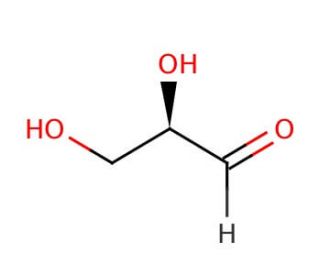

D-(+)-Glyceraldehyde (CAS 453-17-8)
QUICK LINKS
D-(+)-Glyceraldehyde, also referred to as D-glyceral or D-aldose, holds a significant role as a monosaccharide in carbohydrate metabolism. As a three-carbon sugar, it represents the simplest form of aldehyde. D-(+)-Glyceraldehyde is synthesized through various pathways and plays a part in numerous biochemical processes. Moreover, it serves as a common building block for the synthesis of other carbohydrates and acts as a starting material for the production of diverse compounds. Within the realm of scientific research, D-(+)-Glyceraldehyde finds extensive utility. It serves as a frequent intermediate in the synthesis of carbohydrates and serves as a starting point for the production of various compounds. Furthermore, it contributes to the production of glycerol and other polyols, and is involved in the synthesis of polysaccharides and other carbohydrates. The mechanism of action of D-(+)-Glyceraldehyde varies depending on the specific reaction in which it participates. In aldolase-catalyzed aldol condensation, the reaction is facilitated by aldolase, an enzyme that binds to two molecules of glyceraldehyde-3-phosphate and aids in the reaction process. In the aldol condensation reaction, formaldehyde and glyoxal combine to form D-(+)-Glyceraldehyde.
D-(+)-Glyceraldehyde (CAS 453-17-8) References
- The effects of D- and L-glyceraldehyde on glucose oxidation, insulin secretion and insulin biosynthesis by pancreatic islets of the rat. | Jain, K., et al. 1975. Biochim Biophys Acta. 399: 384-94. PMID: 1100111
- Enzymes for the NADPH-dependent reduction of dihydroxyacetone and D-glyceraldehyde and L-glyceraldehyde in the mould Hypocrea jecorina. | Liepins, J., et al. 2006. FEBS J. 273: 4229-35. PMID: 16930134
- L-amino acids catalyze the formation of an excess of D-glyceraldehyde, and thus of other D sugars, under credible prebiotic conditions. | Breslow, R. and Cheng, ZL. 2010. Proc Natl Acad Sci U S A. 107: 5723-5. PMID: 20231487
- Prebiotic access to enantioenriched glyceraldehyde mediated by peptides. | Yu, J., et al. 2021. Chem Sci. 12: 6350-6354. PMID: 34084433
- Metabolic effects of D-glyceraldehyde in isolated hepatocytes. | Maswoswe, SM., et al. 1986. Biochem J. 240: 771-6. PMID: 3827866
- Insulin release in aging: dynamic response of isolated islets of Langerhans of the rat to D-glucose and D-glyceraldehyde. | Molina, JM., et al. 1985. Endocrinology. 116: 821-6. PMID: 3881248
- The metabolism of D-glyceraldehyde by the lens. | Van Heyningen, R. 1969. Biochem J. 112: 211-20. PMID: 4389821
- Pancreatic D-cell recognition of D-glucose: studies with D-glucose, D-glyceraldehyde, dihydroxyacetone, D-mannoheptulose, D-fructose, D-galactose, and D-ribose. | Hermansen, K. 1981. Diabetes. 30: 203-10. PMID: 6110600
- Characterisation of the abnormal pancreatic D and A cell function in streptozotocin diabetic dogs: studies with D-glyceraldehyde, dihydroxyacetone, D-mannoheptulose, D-glucose, and L-arginine. | Hermansen, K. 1981. Diabetologia. 21: 489-94. PMID: 6117495
- The stimulation of insulin secretion by D-glyceraldehyde correlates with its rate of oxidation in islet cells. | Alcázar, O., et al. 1995. Biochem J. 310 (Pt 1): 215-20. PMID: 7646447
- A possible role for glyceraldehyde transport in the stimulation of HIT-T15 insulinoma cells. | Davies, J., et al. 1994. Biochem J. 304 (Pt 1): 295-9. PMID: 7998948
- Conversion of alcohols to methylene acetals by reaction with dimethyl sulfoxide-bromine | Munavu, R. M. 1980. The Journal of Organic Chemistry. 45(16): 3341-3343.
- Calculated and experimental absolute stereochemistry of the styrene and. beta.-methylstyrene epoxides formed by cytochrome P 450cam | Fruetel, J. A., Collins, J. R., Camper, D. L., Loew, G. H., & Ortiz de Montellano, P. R. 1992. Journal of the American Chemical Society. 114(18): 6987-6993.
Ordering Information
| Product Name | Catalog # | UNIT | Price | Qty | FAVORITES | |
D-(+)-Glyceraldehyde, 1 g | sc-255048 | 1 g | $159.00 |