


cyclin E Double Nickase Plasmid (m): sc-419512-NIC
- Target species: mouse
- 20 µg of transfection-ready, purified plasmid DNA; Suitable for up to 20 transfections
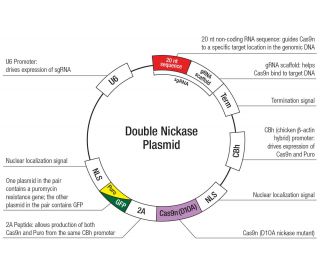
- cyclin E Double Nickase Plasmid (m) consists of a pair of plasmids each encoding a D10A mutated Cas9 nuclease and a target-specific 20 nt guide RNA (gRNA) designed to knockout gene expression with greater specificity than its CRISPR/Cas9 KO counterpart
- Paired gRNA sequences are offset by approximately 20 bp to allow for specific Cas9-mediated double nicking of the genomic DNA, which mimics a DSB
- One plasmid in the pair contains a puromycin-resistance gene for selection; the other plasmid in the pair contains a GFP marker to visually confirm transfection
- cyclin E Double Nickase Plasmid (m) and cyclin E Double Nickase Plasmid (m2) encode distinct paired gRNA designs targeting Ccne1. One or both designs may be available
- Following transfection, gene knockout efficiency can be assayed by WB, IF or IHC using antibody: cyclin E Antibody (E-4): sc-377100

Ordering Information
| Product Name | Catalog # | UNIT | Price | Qty | FAVORITES | |
cyclin E Double Nickase Plasmid (m) | sc-419512-NIC | 20 µg | $410.00 |
Mouse Ccne1 encodes cyclin E, a core regulator of the G1/S transition that activates CDK2 to initiate DNA replication and coordinate centrosome duplication. Cyclin E integrates mitogenic signaling with cell-cycle checkpoint control, influencing replication origin firing, S-phase entry, and genome stability through pathways such as RB–E2F and CDK inhibitor networks. Dysregulated cyclin E activity is associated with replication stress, chromosomal instability, and aberrant proliferation, making Ccne1 a widely used node for studying cell-cycle control in development and disease-relevant models. In mouse systems, Ccne1 perturbation supports mechanistic analyses of proliferation dynamics, checkpoint responses, and DNA damage signaling.
cyclin E Double Nickase Plasmid (m) consists of a matched pair of plasmids engineered for high-specificity editing of the Ccne1 locus in mouse cell lines. Each plasmid expresses a Cas9 D10A nickase and a distinct sgRNA targeting opposite DNA strands within Ccne1. When directed to adjacent sites on opposite DNA strands, the two nickases generate offset single-strand nicks that together produce a staggered double-strand break, requiring coordinated on-target activity from both guides. The resulting DNA break is resolved by endogenous cellular repair pathways, most commonly through non-homologous end joining (NHEJ), leading to insertions or deletions that disrupt Ccne1 function. By requiring dual sgRNA engagement at the target locus, the double nicking approach enhances editing specificity and provides a complementary CRISPR strategy for applications where additional control over targeting precision is desired.
To support efficient identification of edited cells, one plasmid encodes GFP for fluorescent visualization of transfected populations, while the companion plasmid carries a puromycin resistance gene for antibiotic selection. Together, these features support efficient enrichment of co-transfected populations and simplify the validation of Ccne1-disrupted clones.
For Research Use Only. Not Intended for Diagnostic or Therapeutic Use.