
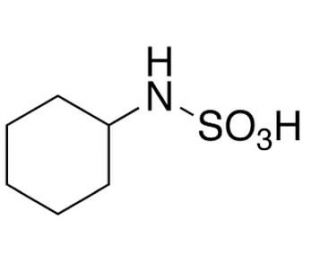

Cyclamic Acid (CAS 100-88-9)
QUICK LINKS
Cyclamic Acid is a useful biochemical reagent that is used as catalyst in the production of paints and plastics. Cyclamic acid, with the chemical identifier CAS No. 100-88-9, is an organic acid with a cyclic structure that dissolves readily in water. It exists as a colorless crystalline solid characterized by its lack of odor and taste. Additionally, it serves as a building block for the creation of other compounds like cyclamate salts and cyclamate esters. Cyclamic acid has found its place in in vitro studies that delve into the consequences of cyclamate salts on cell cultures. Notably, the acid demonstrates non-toxic attributes towards cells, enabling its utilization in assessing the influence of cyclamate salts on processes like cell proliferation and differentiation.
Cyclamic Acid (CAS 100-88-9) References
- Structures of artificial sweeteners--cyclamic acid and sodium cyclamate with other cyclamates. | Leban, I., et al. 2007. Acta Crystallogr B. 63: 418-25. PMID: 17507755
- Improvement of physicochemical properties of an antiepileptic drug by salt engineering. | Rahman, Z., et al. 2012. AAPS PharmSciTech. 13: 793-801. PMID: 22588676
- Degradation of artificial sweeteners via direct and indirect photochemical reactions. | Perkola, N., et al. 2016. Environ Sci Pollut Res Int. 23: 13288-97. PMID: 27023816
- Application of salt engineering to reduce/mask bitter taste of clindamycin. | Barakh Ali, SF., et al. 2019. Drug Dev Ind Pharm. 45: 1871-1878. PMID: 31549523
- Risk assessment related to food additives and food processing-derived chemical contaminants exposure for the Portuguese population. | , ., et al. 2020. EFSA J. 18: e181110. PMID: 33294049
- Longitudinal Profiles of Dietary and Microbial Metabolites in Formula- and Breastfed Infants. | Sillner, N., et al. 2021. Front Mol Biosci. 8: 660456. PMID: 34124150
- Change in the chemical content of untreated wastewater of Athens, Greece under COVID-19 pandemic. | Alygizakis, N., et al. 2021. Sci Total Environ. 799: 149230. PMID: 34364275
- Food Waste Management Employing UV-Induced Black Soldier Flies: Metabolomic Analysis of Bioactive Components, Antioxidant Properties, and Antibacterial Potential. | Lu, J., et al. 2022. Int J Environ Res Public Health. 19: PMID: 35682198
- Effects of Different Chemicals on Sexual Regulation in Persimmon (Diospyros kaki Thunb.) Flowers. | Wang, L., et al. 2022. Front Plant Sci. 13: 876086. PMID: 35693185
- Insulin-like growth factor 1 receptor mediates photoreceptor neuroprotection. | Rajala, A., et al. 2022. Cell Death Dis. 13: 613. PMID: 35840554
- Sulfonic Acid Derivatives in the Production of Stable Co-Amorphous Systems for Solubility Enhancement. | da Costa, NF., et al. 2022. J Pharm Sci. 111: 3327-3339. PMID: 36007560
- From the most to the least flexible nutritional profile: Classification of foods marketed in Brazil according to the Brazilian and Mexican models. | Tomaz, LA., et al. 2022. Front Nutr. 9: 919582. PMID: 36204372
- Fecal microbiota and metabolomics revealed the effect of long-term consumption of gallic acid on canine lipid metabolism and gut health. | Yang, K., et al. 2022. Food Chem X. 15: 100377. PMID: 36211749
Ordering Information
| Product Name | Catalog # | UNIT | Price | Qty | FAVORITES | |
Cyclamic Acid, 1 g | sc-211150 | 1 g | $209.00 | |||
Cyclamic Acid, 50 g | sc-211150A | 50 g | $398.00 |