
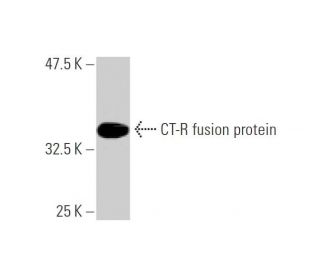

CT-R Antibody (2F7): sc-293299
- CT-R Antibody (2F7) is a mouse monoclonal IgG2a κ CT-R antibody, cited in 1 publications, provided at 100 µg/ml
- raised against amino acids 394-474 of CT-R of human origin
- recommended for detection of CT-R of human origin by WB, IP and ELISA
- At present, we have not yet completed the identification of the preferred secondary detection reagent(s) for CT-R Antibody (2F7). This work is in progress.

QUICK LINKS
SEE ALSO...
CT-R Antibody (2F7) is a mouse monoclonal IgG2a kappa light chain antibody that detects CT-R protein of human origin by western blotting (WB), immunoprecipitation (IP), and enzyme-linked immunosorbent assay (ELISA). Anti-CT-R antibody (2F7) is available as the non-conjugated form. CT-R protein, also known as calcitonin receptor, plays a crucial role in calcium homeostasis by mediating the effects of the peptide hormone calcitonin, which is secreted by the thyroid gland. CT-R (2F7) antibody recognizes a distinct family of seven transmembrane proteins that includes receptors for parathyroid hormone, secretin, and glucagon. CT-R protein is primarily located on the surface of osteoclasts and renal cells, where CT-R (2F7) monoclonal antibody initiates intracellular signaling cascades by coupling with various heterotrimeric G-proteins. This interaction activates multiple signaling pathways, including those involving adenylyl cyclase and phospholipase C, which are essential for regulating bone resorption and calcium levels in the bloodstream. The gene encoding CT-R is characterized by numerous exons and larger introns, allowing for the production of multiple splice variants that exhibit unique functional properties and tissue distributions. These isoforms preferentially associate with specific G-proteins, leading to the recruitment of distinct signaling intermediates, which is vital for the precise regulation of calcium homeostasis and overall metabolic balance. In osteoclasts and embryonic kidney cells, calcitonin binding to CT-R activates the mitogen-activated protein kinases Erk1/2 and protein kinase C through the phosphorylation of adaptor proteins such as Shc and HEF1, demonstrating CT-R′s ability to mediate complex signaling independently of traditional pathways like protein kinase A and adenylyl cyclase.
Alexa Fluor® is a trademark of Molecular Probes Inc., OR., USA
LI-COR® and Odyssey® are registered trademarks of LI-COR Biosciences
CT-R Antibody (2F7) References:
- Protein kinase C antagonizes pertussis-toxin-sensitive coupling of the calcitonin receptor to adenylyl cyclase. | Shyu, JF., et al. 1999. Eur J Biochem. 262: 95-101. PMID: 10231369
- Cytoskeleton-dependent tyrosine phosphorylation of the p130(Cas) family member HEF1 downstream of the G protein-coupled calcitonin receptor. Calcitonin induces the association of HEF1, paxillin, and focal adhesion kinase. | Zhang, Z., et al. 1999. J Biol Chem. 274: 25093-8. PMID: 10455189
- A novel calcitonin receptor gene in human osteoclasts from normal bone marrow. | Nishikawa, T., et al. 1999. FEBS Lett. 458: 409-14. PMID: 10570950
- Calcitonin: discovery, development, and clinical application. | Copp, DH. 1994. Clin Invest Med. 17: 268-77. PMID: 7924003
- Cloning and characterization of a mouse brain calcitonin receptor complementary deoxyribonucleic acid and mapping of the calcitonin receptor gene. | Yamin, M., et al. 1994. Endocrinology. 135: 2635-43. PMID: 7988453
- Cloning and characterization of an abundant subtype of the human calcitonin receptor. | Kuestner, RE., et al. 1994. Mol Pharmacol. 46: 246-55. PMID: 8078488
- The calcitonin receptor stimulates Shc tyrosine phosphorylation and Erk1/2 activation. Involvement of Gi, protein kinase C, and calcium. | Chen, Y., et al. 1998. J Biol Chem. 273: 19809-16. PMID: 9677414
Ordering Information
| Product Name | Catalog # | UNIT | Price | Qty | FAVORITES | |
CT-R Antibody (2F7) | sc-293299 | 100 µg/ml | $322.00 |