
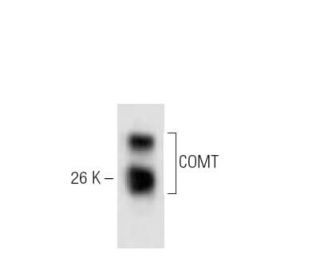


COMT Antibody (4): sc-135872
- COMT Antibody (4) is a mouse monoclonal IgG1, cited in 2 publications, provided at 50 µg/0.5 ml
- raised against amino acids 26-141 of COMT of mouse origin
- recommended for detection of COMT of mouse and rat origin by WB, IP and IF
- At present, we have not yet completed the identification of the preferred secondary detection reagent(s) for COMT Antibody (4). This work is in progress.

QUICK LINKS
SEE ALSO...
COMT Antibody (4) is a mouse monoclonal IgG1 antibody that detects catechol-O-methyltransferase (COMT) in mouse and rat samples through applications such as western blotting (WB), immunoprecipitation (IP), and immunofluorescence (IF). COMT is essential for the regulation of central dopaminergic systems, as COMT catalyzes the inactivation of catecholamines, thereby playing a pivotal role in neurotransmitter metabolism and detoxification. COMT is found in various tissues in both soluble and membrane-bound forms, highlighting widespread physiological significance. Notably, a Val158Met polymorphism in the COMT gene can significantly alter enzyme activity, impacting cognitive functions and the efficiency of the prefrontal cortex, which is crucial for decision-making and emotional regulation. Additionally, COMT facilitates the sequential conversion of estradiol to methoxyestradiol, contributing to the antimitogenic effects of estradiol on vascular smooth muscle cell growth through estrogen receptor-independent pathways. This multifaceted role of COMT underscores importance in both neurological health and vascular function, making anti-COMT antibody (4) a valuable tool for researchers studying these critical biological processes.
Alexa Fluor® is a trademark of Molecular Probes Inc., OR., USA
LI-COR® and Odyssey® are registered trademarks of LI-COR Biosciences
COMT Antibody (4) References:
- Catechol-O-methyltransferase (COMT) pharmacogenetics in the treatment response phenotypes of major depressive disorder (MDD). | Kocabas, NA. 2012. CNS Neurol Disord Drug Targets. 11: 264-72. PMID: 22483292
- The Role of the Catechol-o-Methyltransferase (COMT) GeneVal158Met in Aggressive Behavior, a Review of Genetic Studies. | Qayyum, A., et al. 2015. Curr Neuropharmacol. 13: 802-14. PMID: 26630958
- Catechol-O-methyltransferase (COMT) polymorphisms modulate working memory in individuals with schizophrenia and healthy controls. | Matsuzaka, CT., et al. 2017. Braz J Psychiatry. 39: 302-308. PMID: 28273278
- Depression and Catechol-O-methyltransferase (COMT) genetic variants are associated with pain in Parkinson's disease. | Lin, CH., et al. 2017. Sci Rep. 7: 6306. PMID: 28740224
- Schizophrenia, cannabis use and Catechol-O-Methyltransferase (COMT): Modeling the interplay on cognition. | Bosia, M., et al. 2019. Prog Neuropsychopharmacol Biol Psychiatry. 92: 363-368. PMID: 30790675
- Adverse effect of catechol-O-methyltransferase (COMT) Val158Met met/met genotype in methamphetamine-related executive dysfunction. | Cherner, M., et al. 2019. Addict Behav. 98: 106023. PMID: 31301644
- Investigation of Catechol-O-methyltransferase (COMT) gene Val158Met polymorphism in ovarian cancer. | Abaoğlu, İY., et al. 2021. J Turk Ger Gynecol Assoc. 22: 42-46. PMID: 33389924
- Catechol-O-methyltransferase (COMT) Val158Met Polymorphism and Susceptibility to Alcohol Dependence. | Chaudhary, A., et al. 2021. Indian J Clin Biochem. 36: 257-265. PMID: 34220001
- Catechol-O-methyltransferase (COMT) Val158Met Polymorphism and Prepulse Inhibition of the Change-related Cerebral Response. | Motomura, E., et al. 2022. Psychiatry Res Neuroimaging. 323: 111484. PMID: 35472623
- Catechol-O-methyltransferase gene (COMT) is associated with neurocognitive functioning in patients with sickle cell disease. | Heitzer, AM., et al. 2024. Curr Res Transl Med. 72: 103433. PMID: 38244277
Ordering Information
| Product Name | Catalog # | UNIT | Price | Qty | FAVORITES | |
COMT Antibody (4) | sc-135872 | 50 µg/0.5 ml | $322.00 |